Showing posts with label Environment. Show all posts

Wednesday, February 11, 2015

Vancouver House


Bjarke Ingles is one of the most innovative starchitects in urban design right now.  This blog previous wrote about him in this 2012 post.


Share/Bookmark

Friday, July 13, 2012

Case Study: Ciudad Verde


Site Plan
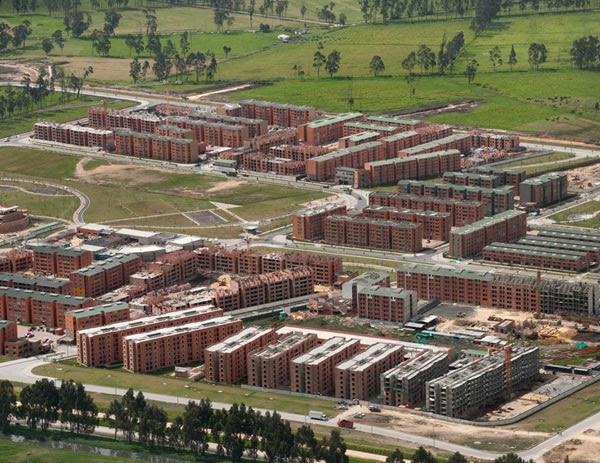
Ciudad Verde will have a major social impact in Colombia (and its model could be adopted elsewhere if successful). Developers will build 36,000 social housing units in the town of Soacha ranging in cost from US$20,000 to US$35,000 each and aiming to accommodate the desplazados – displaced rural townsmen who hail from conflict zones.  Newcomers will have access to a social reintegration program, while the development’s infrastructure includes hospitals, schools and hydroelectric power sources funded through public-private partnerships. (Source: KPMG International, Infrastructure 100: World Cities Edition, 2012)

The Ciudad Verde development involves a housing model called macroproyectos that aims to create small cities outside large urban developments – in this case the country’s capital Bogotá.  The satellite city is expected to create 21,000 jobs.  One third of the 800 acres will be dedicated to social housing, the rest to public space (green parks, roads, health centers, schools, etc.).  In Bogotá, high densities leave three meters of public space per person.  In contrast, Ciudad Verde will provide nine square meters of public space for each resident.  While many secluded low income housing "projects" tend to fail due to lack of access to the outside world, Ciudad Verde takes the important step of integrating Bogotá's TransMilenio bus rapid transit system to connect residents to the center of the capital city.  With such initial success and media attention, the project developers have already been approached by representatives from Valencia, Spain and from The National Fund of Mexico about the possible replication of the Ciudad Verde model and design frameworks.  (Source: Nace una Ciudad en Soacha, 2011)

 
The lead developer is Amarilo SA and their development partners include Bolívar, Colsubsidio, Soluciones Inmobiliarias, Ospinas-Emezeta, Marval, Prodesa, Urbansa and Mendebal-Coninsa Ramón H.  In total, the Ciudad Verde project will require US$145 million in investment with the developers expecting US$1.2 billion in revenue. (Source: Gran proyecto de vivienda social en Colombia, 2010)
Rendering Plan
Ciudad Verde Today
Ciudad Verde Today
Ciudad Verde Today


Share/Bookmark

Friday, May 04, 2012

Eco-Industrial Parks


Eco-Industrial Parks (EIPs) cluster manufacturing plants in a single location where the by-products of one facility contribute to the inputs of other onsite facilities.  Seeking to create circular economies that recycle waste and encourage the sharing and integration of resources and infrastructure, EIPs facilitate “cleaner production within companies and design of both primary and by-product chains among companies.”  By promoting closed systems manufacturing, these parks encourage the local consumption of goods and recycling of by-product waste.  Incorporating a systems approach to these processes, EIPs can revolutionize sustainable industrial development.

Traditional industrial parks capitalize on the economic benefits of clustering.  The clustering of related business activity leads firms to gain additional productive advantages through increased specialization (in terms of human capital and physical infrastructure) and through efficient infrastructure networks.  Industrial parks typically concentrate like-businesses and companies around a common economic sector to capture these efficiencies. 

Instead of concentrating businesses based on a single industry, EIPs take clustering one step further – they create closed “waste-to-feed” resource systems.  EIPs assemble groups of companies based on waste production and inputs.  Planners and management teams organize eco-industrial parks by first identifying the by-products of large anchor tenants.  “If a major by-product supply stream will be an attractor to companies that can use it,” observes Ernest Lowe in an EIP case study, “then [EIPs] use that in recruitment.”   Planners and management teams embark down a successive chain of recruiting businesses that use the anchor tenants’ by-products as inputs and subsequently search for others who could utilize the next set of industrial by-products.  EIPs thus foster the development of closed resource systems and the perpetuation of circular economies.

At Hemaraj Eastern Seaboard Industrial Estates (HESIE) , an EIP located along the Gulf of Thailand, an automotive cluster sustains a 420-factory circular economy.  Anchored by Thailand’s automotive production lines, excess scrap metal is sold to parts manufacturers, to electronics companies, and to building-material factories within the industrial complex.  Plastics firms and agrochemical businesses reuse by-product gases produced at an electrical generation plant and at the automotive factories.  Co-generation heat capture powers additional energy throughout the industrial park.  

Similarly, the Industrial Symbiosis park in Kalundborg, Denmark houses 20 integrated firms.  Centered on a coal-fired power plant, excess heat from cooling water is directed to local fish farms and excess steam routed to the biotech facilities for enzyme production.  Both the fish farms and the pharmaceutical companies produce agricultural fertilizers as bi-products for pig feed in the nearby farms, which then feed Kalundborg’s residents.  Ash from the power plant is also used by the local cement company.  And a plasterboard manufacture utilizes the power plant’s sulfur dioxide and gypsum bi-products.


Share/Bookmark

Wednesday, April 04, 2012

Hedonistic Sustainability


In this TED Talk with Bjarke Ingels, the world renowned architect demonstrates how innovative design can creatively integrate buildings with society.  A new city hall in Thailand incorporates government transparency and public participation in physical form by making conference rooms open to public view from the outside.  A waste-to-energy plant in Copenhagen draws a mountain form into the Copenhagen skyline (with rooftop ski slope included!).  The power plant also raises awareness of carbon emissions by releasing the gaseous byproduct in equally measured smoke rings to give residents a psychical interpretation of one ton of CO2.  In what is most likely the first Just a Thought... post on architecture, the cultural implications and the pure "wow" factor of the Bjarke Ingels Group's works speak for themselves.  Expect to see new Bjarke Ingels inspired constructions across the world in the 21st century.

Good looking out to Mr. Pomeroy for finding this video.


Share/Bookmark

Wednesday, March 21, 2012

Case Study: Water Infrastructure in Karachi, Pakistan

Karachi's Drainage Systems Map
(Click to Enlarge)
Karachi, Pakistan suffers from many problems: economic, social, infrastructural.  In anticipation of exponential population growth in the coming years, that Asian Development Bank funded the Karachi Mega Cities Preparation Project.  The project seeks to identify the structural problems hindering economic growth of the city.  This case study will explore reoccurring infrastructural problems highlighted by the Asian Development Bank that pertain to water and sanitation systems.

Water Service
Supply
The Karachi Water & Sanitation Board (KWSB) is a government agency that receives funding to provide water services to Karachi.  Due to its close proximity to the coast, Karachi’s groundwater is mostly saline and not potable.  Therefore, the city draws its water mainly from two surface water sources: the Indus River and the Hub Dam.  The Indus River is over 100 km away from the city’s center, while the Hub Dam is only 35 km away.  KWSB pumps a total of 540 million gallons of water per day to the city.  Of this, only 350 million gallons of water is treated daily at the Hub Dam.  Treatment consists of clarification, filtration and chlorination.  The remaining 190 million gallons of untreated water flow directly from the Indus River to pipelines connected to domestic residences.  Not surprisingly, untreated water is not differentiated for industrial or commercial use.  An existing project (in the works as of 2005 when officials drafted the original Karachi Mega Cities Preparation Project) plans to expand the Indus River’s extraction capabilities by an additional 100 million gallons per day.  Once completed, the shortfall of treatment capacity will have astoundingly reached close to 300 million gallons of untreated drinking water pumped to the city each day. 

Distribution
In large parts of the city, water access is only intermittent.  KWSB provides neighborhoods with water on a “rotating basis,” which, according to their optimistic claims, means supplying water to all areas for at least 2-6 hours each day.  The Karachi Mega Cities Preparation Project report suggests KWSB’s estimates are over-exaggerated; services often operate only 2-3 times a week.

The unreliability of the network stems from the combination of variable water pressure and “unaccounted-for-water” leakage.  The lack of constant pumping to all pipes connected to the water grid and the existence of poorly attached “informal” connections interrupt the water flows and effect water pressure.  The Asian Development Bank concludes that “intermittent flow and variable pressure in the system [] allows the ingress into the supply system of faecal contaminated groundwater and surface water.”  Tellingly, the World Health Organization found that over 75 percent of water samples coming from Karachi are substandard. 


Share/Bookmark

Friday, February 10, 2012

The Island President Deposed


Film maker Jon Shenk crafted an extremely moving 6 minute documentary about Mohamed Nasheed, the now ex-president of the Maldives (Nasheed was forced out of office by gunpoint on Tuesday).  The short film walks through Nasheed's rise from political prisoner to first democratically elected leader of the Maldives.  As a vulnerable enclave of islands, Shenk follows the president's push to make the islands the first carbon neutral country in the world.  His fight against international business pressures leads up to this week's unrest.  To visually experience Nasheed's rise and fall, watch the short film above or read Shenk's written chronicle of the Maldives president.


Share/Bookmark

Wednesday, December 07, 2011

Cities on the Sea

Source: Seasteading.org

“Taxation without representation” still rings true for many libertarians.  The possibility to break off from a mother country to create an autonomous self-governing city-state is a possibility that is gaining traction and funds from wealthy backers.  Since governments lay claim to all land across the globe, wealthy libertarians, like Peter Thiel, the founder of PayPal, and Patri Friedman, the grandson of Milton Friedman, assembled a think-tank, the Seasteading Institute, to study the feasibility of creating a floating, off-shore city that remains out of reach of national governments.  “Our Mission,” writes the Institute on their website, “to further the establishment and growth of permanent, autonomous ocean communities, enabling innovation with new political and social systems."

Source: Seasteading.org
The Seasteading Institute explores cruise-ship style offices, apartments, and retail centers, which unfortunately cannot withstand the storms of the high seas.  Oilrigs provide other platforms, but can cause seasickness when they rock with waves.  And cities built above small island foundations raise problems with international law, as these would fall within the grey area of countries’ territorial waters (12 miles offshore) and their exclusive economic zones (200 miles offshore).

A futuristic shipyard in outer space
Source: OnRPG.com
While libertarians are quickly written off as fanatics who wish for the yesteryears of 1776 colonial rebellion, those who dream of cities in space are accepted by society as sci-fi futurists – yet the two concepts are extremely similar.  A leading presidential candidate has even suggested the building of "a massive new program to build a permanent lunar colony to exploit the Moon's resources."  Ocean city designs would most likely draw ideas of self-sustaining agriculture and energy uses from prior outer space living competitions.  Likewise, future space cities would adopt successes and note failures of condensed sea living.  While the libertarian city on the sea dream attempts to break barriers to free market concepts (like the uninterrupted movement of labor that could be lubricated with the elimination of visa or immigration laws), those idealists ignore the more cost effective existing terrestrial zones that already cater to libertarian freedoms.

Source: The Economist
Pushing political views aside and looking at cities on the sea from the Seasteading Institute’s point of view as a creative exercise, these think tanks get funding to conceptualize what it would take to build a new country from scratch in the modern era.  They also get to explore designs of how to feed and sustain populations disconnected from traditional terrestrial living.  While floating metropolises may be only slightly more realistic at this point than building a real life Death Star in space, ocean-based cities rethink traditional models of urban living.  At the very least, the Seasteading Institute’s studies will demonstrate ways to integrate sustainability techniques with underlying urban infrastructure.


For more on Seasteading and floating communities, read The Economist's Seasteading: Cities on the Ocean.


Share/Bookmark

Sunday, November 06, 2011

Population Growth and Development


To further delve into humanity's 7 billion landmark reached last week, I feel I didn't sufficiently explain the demographic transition humanity follows.  As countries develop, death rates drop.  With advances in medical technology and sanitation, people live longer.  High birth rates then take about a generation to fall more in line with death rates.  Only then do populations reach slower, stabilized growth levels.

This demographic shift explains the Earth's 7 billion, via worldwide growth and development.  The big spike in population growth over the past 150 years represents the large portion of humanity that has already experienced declining death rates.  That alone is pretty impressive!  But this unsustainable level of rapid growth will soon slow.  Although humanity exponentially jumped 6 billion people since 1800, the population should only expand 3 billion more by 2100.  Water shortages and environmental impacts aside, it is pretty impressive that our food systems, our political systems, etc. are so advanced that we can provide for this many people.  We can grow enough food and distribute that food to 7 billion people.  Our systems surely are not perfect, but, if you consider that for most of history everyone who was not nobility was an impoverished peasant, we've definitely made some progress.  I'm proud to be part of the world of 7 billion!


Share/Bookmark

Monday, October 31, 2011

Happy 7 Billion Day!


On Halloween, what’s scarier than Thriller-like zombies, Jack Sparrow pirates, or scalpel carrying nurses?  In 2011, October 31st also marks the symbolic day in which the world’s population reaches 7 billion.

Amazingly, the world can sustain such large populations.  With technological advances in food production, medicine, and sanitation, humanity today can support over 7 billion lives.  Population growth may slow, but by the turn of the next century, the Earth will already be crowded with over 10 billion people (the UN estimates that people will reach the 10 billion landmark even sooner in 2083). 

While obvious concerns of overpopulation, increased inequality, and environmental impacts accompany any mention of population growth, the shear feat of man’s growth remains remarkable.  People should celebrate that, in itself, 7 billion represents enough food and resources to keep people alive and reproducing at historically unprecedented levels. 

7 billion is humanitarian.  7 billion is agricultural, technological, medical, economic, political, social progress.  7 billion is an incredible milestone to reach.  The more complex our systems become, the more people humanity can sustain.  Diminishing the negative effects (poverty, climate change, etc.) should be the goal of today’s generation.  But by no means should 7 billion symbolize the fall of mankind.  7 billion is a reason to celebrate!  Ignoring the responsibilities that accompany such large population growth is the sin.


For more on the world's population, check out National Geographic's special series on The 7 Billion.


Share/Bookmark

Wednesday, August 31, 2011

Property Insurance?

As part of signing a lease, all renters in my building must buy property insurance.  After this weekend's hurricane flooding, I found this pamphlet in my mailbox:

Click photo to enlarge
"NOTICE! This policy does not cover Flood Loss."

In a bright red box, First American Property & Casualty Insurance Company lets us know "This policy does not cover Flood Loss." I heard these sorts of stories after Katrina, but it's still quite a shock to experience it yourself.  

First American claims to "cover personal property owned or used by an 'insured' while it is anywhere in the world."  Although this sounds great, let's scroll through the 19 pages of fine print exceptions.  Listed exceptions are fire, electrical, explosion, or smoke damage; theft, vandalism, riot or civil commotion; freezing, ice, windstorm, hail, falling objects, or weight of ice, snow or sleet; business or professional services; water damage or flooding; landslide, mudslide, or mudflow; bodily injury; sudden and/or accidental tearing apart, cracking, burning, or bulging; neglect; Earth movements, including earthquake, land shock waves, or tremors before, during, or after a volcanic eruption; Sexual molestation, corporal punishment or physical or mental abuse; Communicable disease; Controlled substances; vehicle, hovercraft, or aircraft damage "this includes self-propelled missiles and spacecraft."  My personal favorite exception is war: "Undeclared war, civil war, insurrection, rebellion or revolution; Warlike act by a military force or military personnel; or Destruction, seizure or use for a military purpose. Discharge of a nuclear weapon will be deemed a warlike act even if accidental."

I can't even make up some of the things First American excludes (spacecrafts, really?)  My only lingering questions still is (and I honestly am curious), WHAT DOES PROPERTY INSURANCE ACTUALLY COVER?!?!?


Share/Bookmark

Tuesday, August 30, 2011

Reverse Culture Shock

One of my biggest fears returning to the States was reverse culture shock.  In the past I've found that reverse culture shock is far worse than regular culture shock.  Going to new places, I've learned to expect the unexpected and the sheer excitement of traveling usually overcomes any anxiety of immersion in new countries.  On the other hand, reverse culture shock destroys the myth of Home Sweet Home.  Home is supposed to be the one place in the world that never changes, where childhood memories freely exist, and the comfort of the familiar welcomes all its lost children back.  Unfortunately, after living in a strange, far away land, our inner standards of normal shift. Home, on our re-calibrated standard, no longer feels normal.  Things are off.  With their guards down, travelers often fall victim to the depressive reverse culture shock.

When I first lived abroad for six months in Costa Rica and Nicaragua, I got lost in the abyss of reverse culture shock.  For the cost of a single beer in a Boston bar, I could buy 20 beers in Nicaragua, or pay an entire week's wages of local factory workers.  Instead of enjoying social nights on the town with friends, leaving my house became disturbing and mentally draining.  The frugal me hid from the excesses of the American lifestyle.  

This time, familiar with what to expect after two years away, I came back to Boston preparing for the worst.  I understood that prices would be high.  If I saw my peers paying for an absurdly priced sandwich, I knew that I should probably go along with the crowd and not worry about individual purchases.  With this mentality, I overcame reverse culture shock.

But needless to say, this past month, there have been instances that utterly freaked me out.  Of all places, nothing was quite as overwhelming as taking a trip to the supermarket.  There, all the vegetables are perfectly grown: all gigantic, without any blemishes, colored with deep greens and reds, and all identically created.  This food does not feel natural.

While I haven't succumbed to a cultural depression, strange nightmares about giant green peppers or attacks of the killer tomatoes might just be the preferable alternative to never leaving my house.

Star Market in Chestnut Hill


Share/Bookmark

Wednesday, June 08, 2011

Bridge to Nowhere

Rurre is the pueblo on the bottom of the photo, Buenadventura across the river. The proposed bridge project wants to connect the two from the narrowest pass in the river (left).  The people want the bridge to pass over the island on the right.

In addition to the incredible scenery and laidback lifestyle of the Amazon Basin, Rurrenabaque is currently wrestling with its own development issues. 

Rurrenabaque and Buenadventura are locked away from major cities.  It’s already at least a 20-hour ride for trucks to transport goods back and forth from La Paz and it’s a three-day journey to Santa Cruz.  Then, between the two pueblos rests the Río Beni, a large river that trucks, buses, and passengers must cross by tugboat/ferry.  The pueblos, totaling about 14,000 people combined, boast their quaint seclusion as the best reasons to live in quiet of the jungle.  But a bridge project threatens Rurre’s identity.

For the past fifteen years, Rurre built its reputation and economy around tourism and cattle.  Resisting the urbanization trends of other regional capitals, Rurre attracts people who are more comfortable with small town life.  But recently, the central government signed off on financing a bridge to connect the gap between Rurre and Buenadventura.  This happened without any input from the local governments or allowing for public participation.  The people are furious.  The proposed bridge will pass right through the center of Rurre, wiping out the school district; the central government suggests relocating the elementary school and high school to the outskirts of town.  The empty streets that freely give pass to small motorcycles risks large amounts of freight traffic jamming up Main Street (Calle Comercio) and the rest of the center. 

Tugboat ferrying a truck from Rurre to Buenadventura.
The town continually cries to move the project to the entrance of town, crossing over an island in the river, and providing the least disruption to the calm way of life.  But the central government refuses to change its plans, or more importantly its price tag, from $15 million to $21 million for “such a desolate region.”   Logically, the pueblo’s response is that the original proposal wasn’t even requested by the people.  They did not ask for this bridge and have trouble seeing the benefits of adding the culturally destructive construction.  Not enough commerce or traffic travel through Buenadventura to justify the spending.  The pueblo is a deadend pass.  Although the capital has yet to publically specify the need for such a project, most figure that the bridge would allow for easier access to logging in the fragile Amazon forest and for increased petroleum exploration.

For local commerce, people already commute easily across the river using the ferries that have become a staple allure of the pueblos.  An intrusive bridge would destroy the picturesque views.  As for the added commercial movement, a local Beniano told me, “If we wanted a more developed city, we would move to La Paz.”  Rurre will fight to the death (or to its expansion) to oppose this disruptive bridge.

Note: This bridge project gave me an excuse to almost stay in Rurre.  If I spent a month investigating the project, I could have written another article and enjoyed life there.  We all know that I get off on regional development issues like this (economic vs social effects of a giant project...this is a planner's dream), so I was asking everyone I met in Rurre about their opinions of the bridge.  I even visited the governor’s and mayor’s offices for more information on the subject.  With our bags packed and our Moto-Taxis waiting at the door outside of the hostel, Vivi turned to me and said, “Are you sure you want to leave?  If we leave now, it’s much harder to turn back.  But if we stay, we could kick it here for another couple of weeks.”  It was hard to get onto the bus.


Collusion in the Amazon

A tour group passing on the way to Madidi National Park.
On other economic development news from the rainforest, the travel agencies are the most apparent work of collusion I’ve seen in a while -- a huge benefit to the pueblo, a big hit to the wallet for a frugal backpacker.  All the agencies agree on the same two tours to offer to travelers.  Their options are standardized across the agencies and their prices set.  This eliminates all variation and forces all tourists to take the steeply priced adventures.  Last month, costs of these packets rose 50% (and the survival course we wanted to take has ceased to exist).

Collusion in Rurre seems like a great system  for the tour agencies until the market gets too saturated when other money savy locals see that they can make a killing providing the simple tours.  When enough people start offering these same trips, someone is bound to break the collusion bond.  To keep the competition down, the tour agencies need to create a licencing system to create high barriers to entry.  Either way, tourist dollars are flooding into Rurre.


Gasoline Arbitrage

Bolivia also subsidizes its gasoline.  At the one national gas station in Rurre, prices are regulated, but the tanks are often run dry.  Locals resell gas on the black market for close to a dollar/liter more than the gas station.  In large cities like La Paz, low gas prices are strictly enforced.  This isn't the case in Rurre where supply isn't always abundant.  It’s interesting to watch market economies clash with central planning and the effects of those who take advantage of free market arbitrage.


Share/Bookmark

Wednesday, February 16, 2011

30,000 Indigenous Amazonians Take on Big Oil


A must watch trailer of Crude, an award winning documentary that follows the Lago Agrio lawsuit.
For anyone unfamiliar with the court case, Crude provides vital background information and
integral visuals that precede this blog post.

An Ecuadorian court earlier this week ordered Chevron Oil to pay $9 Billion in environmental damages for dumping toxic waste and crude oil into Amazonian waters.  Even after winning one of the largest environmental lawsuits ever, indigenous Ecuadorians are demanding more for the destruction of vulnerable rainforest lands, countless deaths, chronic illnesses, and irreversible economic losses.  On behalf of the 30,000 people in the class-action lawsuit, lawyers are filing an appeal, seeking an unprecedented $113 Billion in retributions.

Between 1964 and 1990, Texaco, which was bought buy Chevron in 2001, deliberately poured and leaked out over 30 billion gallons of toxic wastewater and crude oil into areas surrounding the Lago Agrio Oil Field (Comparatively, Exxon Valdez spilled 10.8 million gallons and BP/Deepwater Horizon spilled 205 million gallons).  In order to lower costs (by not adhering to environmental standards or responsibility), Texaco dumped unusable waste without treatment.  The savings helped raised profit margins $3 per barrel.  When Texaco left Ecuador in 1990, they left behind a legacy of hundreds of open pits filled with hazardous waste.

But even in face of the court’s ruling earlier this week, Chevron continues to muscle its own stance, publically stating its refusal to adhere to Ecuadorian law and that the oil giant will not pay the $9 Billion requital.  If Chevron fails to publically apologize for its role in pollution surrounding Lago Agrio within 15 days, the fine doubles.

The Lago Agrio Oil Field lawsuit displays the worst spectacle of international law. The case frustratingly bounces around court systems on three continents.  After 17 years the litigation process still drags on.  Last week, as Ecuadorian judges were ready to condemn the oil company, a Manhattan Federal District Court and an international arbitrator called for Ecuador “to suspend or cause to be suspended the enforcement or recognition within and without Ecuador of any judgment.” This was not based on poor evidence or corruption; the delay provides time for international courts to verify if the Ecuadorian trial violates a trade pact with the US.  Although in 2004 a US court unanimously ruled that Chevron could not shift the blame (and any losses) to the Republic of Ecuador because the 1965 Joint Operation Agreement was never signed by any members of government or the state petroleum company.  Needless to say, the indigenous plaintiffs are furious over the international orders they contend were “issued by a private arbitration panel that prohibited the Ecuadorian plaintiffs from presenting their case.”  Chevron now wants all appeals to move back to the US or the Hague.

The charade is nothing new.  From day one, the Lago Agrio Oil Field case has been marred by public relations meddling, false accusations, impeding bribery, and refuted scientific studies.  Studies have shown that inhabitants of the effected Amazonian area have elevated cancer rates 150% higher than controls.  But Chevron scientists horrifically campaign to disassociate polluted ground water from cancer.  They claim that the hydrocarbons (polycyclic aromatic hydrocarbon) found in the ground water cannot be sufficiently isolated in studies so as to rule out with 100% certainty that other environmental sources don't cause the debilitating diseases.  Chevron scientists call studies that link the contamination and cancer “the product of fraud and is contrary to the legitimate scientific evidence.”

Additionally, the smear campaign against the Ecuadorian plaintiffs led to a new racketeering suit against the plaintiffs and their legal team – again, not a surprise tactic from Chevron.  In 2009, Chevron won a ruling of mistrial when they provided video evidence of a man bribing the presiding judge.  The man speaking to the judge in the video was found to be a “long-time Chevron contractor,” who is currently living in the US.  Before disappearing from public light, this unnamed contractor claimed on tape to have “enough evidence to ensure a victory by the Amazon communities if Chevron failed to pay him what he was promised.”  The man has not spoken out and Chevron currently provides the contractor with an undisclosed amount of paid living expenses.

The Lago Agrio fiasco is the epitome of a nauseating fight between indigenous populations and an oil company with bottomless pockets.  The indigenous are constantly strong-armed with legal technicalities and manipulation of the court systems.  While many facts remain sealed under court order, the mockery of international loopholes remains apparent.  How can transnational corporations be held accountable if they refuse to recognize the constitutional law in the countries in which they operate?   For an extra $3 a barrel, Texaco/Chevron destroyed a region and damned generations of its inhabitants.  Even in the face of legal battles, Chevron continues to show that it is above the law, morality, and human rights.  In a statement issued after Monday’s ruling, Chevron spokesman Kent Robertson signaled the oil giant’s corporate stance: “The Ecuadorian court’s judgment is illegitimate…Chevron does not believe that today’s judgment is enforceable.”


Share/Bookmark

Thursday, February 10, 2011

Did Global Warming Cause the Arab Riots?


It’s no secret rising food and commodity prices have driven people in poor countries to desperation.  Dictators in place for thirty years are finally falling after a combination of missteps.  Following years of corruption and mismanagement, crumbling financial security is prompting traditional powers to eliminate costly subsidies on food and oil.  All the while, commodity prices are rising with the depletion of crops due to floods and droughts.  Reaching a tipping point with exorbitantly high prices for basic goods, desperate people are fighting back against the status quo.

Nobel Prize Winning
Economist Paul Krugman
Last month I discussed how rising food prices contributed to the riots in Tunisia, in Egypt, and in Bolivia.  I also explained how Iran successfully managed (at least for the time being) to divert attention away from the rising costs of basic goods.  Today Paul Krugman (the Nobel Prize winning economist and movie star extraordinaire in Get Him to the Greek) went one step further.  He asserted that global warming caused the recent unrest.

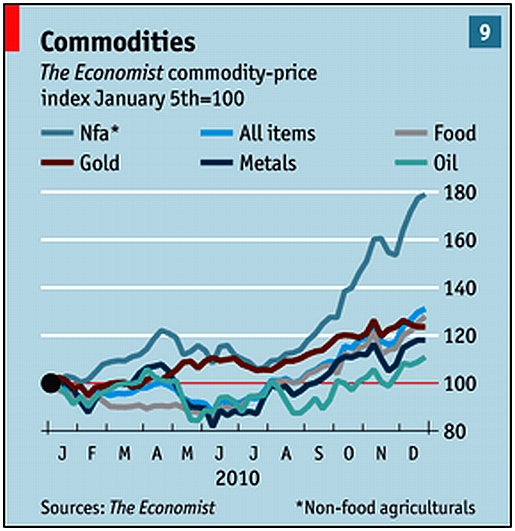
Most economists cite a number of factors contributing to rising commodity prices. Commodities began their steep rise with the 2008 boom coinciding precisely with the stock market’s collapse.  The financial crisis made government issued currencies less stable, thus commodities became coveted assets.  Around that same time, a large shift in investment directed capital towards emerging economies: Brazil, Russia, India, and China.  BRIC nations’ growth increased global demand for commodities as the countries became progressively wealthy and their purchasing power swelled.  And with recent floods and droughts, extreme weather destroyed crops in some of the biggest food producing nations, cutting world food supply and driving up prices.

Up until July, food prices were 
dipping while other commodities 
were on the rise.
Krugman’s assertion is that popular rationales relating to the financial crisis and the emergence of BRIC economies are misguided. Changes in wealth don’t affect the amount of food people eat (with the exception of extremely poor countries, ie, not BRIC nations, and with the other exception of meat consumption, ie, not wheat, corn, rice, or other grains).  Also, food prices, in relation to other non-food commodities, have grown slower than their counterparts from September 2008 to Summer 2010.  Petroleum products and precious metals witnessed steeper price rises than those of food experienced, which would indicate that food prices, relative to others, have not grown as fast as an economic crisis trigger would suggest.  The graph on the left shows 2010 commodity prices, with food well below the average in the first half of the year.

Krugman’s argument stems from the sudden rise of food prices in July 2010.  Russia, the world’s third biggest wheat exports, sold 63.7 million metric tons in international markets in 2009. This past summer, Russia experienced 100˚F temperatures for the first time in Moscow’s history.  In response to arid droughts, grain production in the former USSR dropped almost 40%.  China, the world’s largest producer of wheat, is “bracing for its worst drought in 200 years”.  This year, 12.75 million acres, or 37%, of its wheat fields have already been destroyed.  For the first time in the Communist Regime, China might have to import wheat from international markets.  Australia, Canada, India, and Brazil were all plagued with floods, contributing to the total wipeout of 20 million tons of global wheat production per month.  Accordingly, world food and commodity prices keep steadily rising.
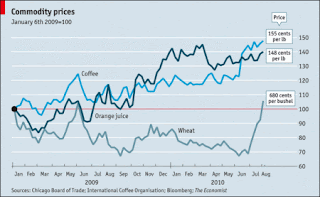
Wheat prices skyrocketed in July 2010, just as 
Russia’s drought began.
Diversified world production (with crops grown on many different continents) and disaster-ready stockpile reserves all account for normal weather afflictions like isolated droughts or small river-caused floods.  Isolated cases, like the 2004 Indian Ocean tsunami, can stand alone.  But patterns of extreme weather, such as those in 2010, suggest a global trend.  2010 was the hottest year on Earth.  According to the National Oceanic and Atmospheric Administration, Earth’s temperature rose 1.22˚F higher than normal.  20% of the world’s landmass reached record high temperatures! As Krugman notes, “both droughts and floods are natural consequences of a warming world: droughts because it’s hotter, floods because warm oceans release more water vapor.” Droughts and floods kill crops and whither world food supply.  This new wave of extreme weather pushes commodity prices higher than ever.

Even though the current unrest is not as singly focused on global warming as Dr. Krugman suggests, extreme weather is driving up food and commodity prices to record highs.  Poor, hungry people in Tunisia and Egypt desperately fight against rising food prices.  Despite their lack of familiarity with the intricate workings of commodity exchanges, people taking to the streets directly feel the effects of expensive food in their wallets and stomachs.

Resistant business interests provide powerful lobbies against structural change driven by Global Warming environmental regulation.  They wholeheartedly attack the merits of climate change.  But when the status quo gets shaken with political upheaval, businesses, politicians, and the general public all take notice.  At this point, the new order in the Middle East might not be directly tied to climate change.  However, if food driven riots continue to manifest, food security will soon become too big a problem to ignore.


Share/Bookmark

Monday, September 20, 2010

“ 'There is really no debate about climate change in China,' said Peggy Liu, chairwoman of the Joint U.S.-China Collaboration on Clean Energy, a nonprofit group working to accelerate the greening of China. 'China’s leaders are mostly engineers and scientists, so they don’t waste time questioning scientific data.' The push for green in China, she added, 'is a practical discussion on health and wealth. There is no need to emphasize future consequences when people already see, eat and breathe pollution every day.'

And because runaway pollution in China means wasted lives, air, water, ecosystems and money — and wasted money means fewer jobs and more political instability — China’s leaders would never go a year (like we will) without energy legislation mandating new ways to do more with less. It’s a three-for-one shot for them. By becoming more energy efficient per unit of G.D.P., China saves money, takes the lead in the next great global industry and earns credit with the world for mitigating climate change.

'China is changing from the factory of the world to the clean-tech laboratory of the world,' said Liu. 'It has the unique ability to pit low-cost capital with large-scale experiments to find models that work.' China has designated and invested in pilot cities for electric vehicles, smart grids, LED lighting, rural biomass and low-carbon communities. 'They’re able to quickly throw spaghetti on the wall to see what clean-tech models stick, and then have the political will to scale them quickly across the country,' Liu added. 'This allows China to create jobs and learn quickly.' ” -- NYTimes, 9/18/2010


Share/Bookmark

Tuesday, April 06, 2010

Email from Mas

I've written about Haiti's and Chile's recent earthquakes. The newest quake in Baha California registered 7.2 on the Richter Scale. Masato, who lives in San Diego, 100 miles away from the epicenter, sent out this email:
I felt pretty strong earthquakes on Sunday on top of a rooftop bar [in San Diego]. Here are some pics my co-worker took in Mexicali. Those are mountains shaking [in the third picture]. Pretty wild.
Thanks for the update Mas.


Share/Bookmark

Sunday, March 14, 2010

Huayana Potosí

Climbing Huayana Potosí was easily the scariest day of my life. From now on, it's only bunny hills for me when I go skiing. If I ever see Cliff Hanger on TV, I'm turning off the tube. Hell, if I even see any other Sly Stalone movie on TV, I'm changing the channel to avoid any reminders of Cliff Hanger. Scaling the mountain was even scarier than the Costa Rican drive-by shooting I witnessed in San Jose. When my parents warned me of the dangers of mountaineering, as they similarly do before every adventure, I took my dad's words as another cry for wolf. But this was the most terrifying thing I've ever done.

After spending the first day hiking past the rocky bottom half of Huayana Potosí, we reached the High Mountain Camp at 5,130 meters. The stone walls of the small cabin were lined inside with plywood for brave backpackers to leave advice scribbled on the walls: "Go back." "This was the worst experience of my life!" "I've never felt so much pain before." "I went to the heavens only to find the devil." We nervously laughed and decided these early warnings were probably just a joke played by the guides to scare us.
In the middle of the night, at one AM, we started our trip to the summit in order to reach the top by sun rise. Bright pin holes in the sky dotted the Milky Way Galaxy. In the east, a faint halo above La Paz glowed as the city lights reached up towards the heavens. With the moon sleeping through the night and tucked in behind the horizon, headlamps lit our path in the pitch blackness. Thankfully, the light only illuminated three feet in front of me; I couldn't look back down the steep slopes of the mountain. We all were tightly secured to our guides with a rope and harness around our waists, but we were never securely attached to the mountain. Throughout the night, I silently followed my guide Mario as we trekked through the thick snow.

As we calmly moved forward, my deep breathing fought the thin air. Suddenly, with one wrong step, I dropped waist deep with my feet dangling above a bottomless cave. The wind frequently blows snow across the mountain face, covering ice caves with thin layers of snow. With my icepick in one hand and my free arm reacting quickly, I saved myself from this sure plunge to the afterlife. Super Mario laughed as I pulled myself away from death. We continued upwards.
The higher we climbed, the thinner the air became and the heavier my gasps for oxygen grew. We ice picked up a thrillingly terrifying 75 meter stretch up a 90 degree face of ice (in the photo, notice the cliffs on the right/center of the picture). I kept praying that the metal spiked crampons attached to my feet sturdily held me in place hovering in the air, like Spiderman climbing up the sides of skyscrapers. If only I could have seen below (like I did on our decent -- the absolute most petrifying portion of the entire climb), I would have noticed that we joined the cliff close to its peak, the fall dropped below our feet for hundreds of unseen meters. But when scaling this ice wall, I can't begin to explain the adrenaline rush and relief I felt when I finally reached my gloves over the last icicle and felt packed snow and a flat incline.

When the rush began to fade, the altitude began to take its toll. The usual altitude induced headache didn't overcome me. It was the thin air that absolutely drained me at accelerated speeds. It caused extreme fatigue to the point of delirium, wobbly legs, and drunken balance. As we approached our final push to the top, crossing the last leg, a steep slope off the edge of the mountain, I couldn't keep myself standing or walking in a straight line. The sun began to rise. With the thin atmosphere, UV rays penetrate the cold snow, melting the powder into thick packing snow (the good stuff for snowballs). This dangerously sticks inside the crampons, transforming them into uncontrollable ice skates. I found this out when I unexpectedly found myself skidding off the edge of a steep slope. My stomach dropped as it does in roller coaster rides before my mind could comprehend what was happening. I was literally falling off the edge of a mountain. For 25 meters I slid. Yank. Super Mario caught the rope attached my to waist and instantly stopped my free fall. I couldn't help laughing as I cautiously grabbed my icepick (my knuckles stinging after gripping the metal rod so tightly) and climbed back to the path.

At 5,900 meters, after looking death straight in the eyes for a second time, my oxygen deprived legs and overstretched lungs admitted defeat. With the summit of 6,088 meters (20,000 feet) in sight, Mario and I turned around.

Of six who attempted to conquer Huayana Potosí on Sunday, only two made the summit. A Colombian in my group, who was clearly worse off than me, tried to go the last leg. He threw up midway, forcing him and his loyal girlfriend to head back toward base camp. The last survivor who didn't make it watched jealously as his friend crossed the last bridge of ice to greatness. The two who did summit Huayana Potosí has both been living in La Paz the past year. One was a Swiss volunteer working with street kids in the city and the second was a grizzly Belgian scientist researching glacial recessions.

Twenty years ago, Huayana Potosí did not have a rocky bottom. Both days of hiking, trekked through thick snow -- the type of snow that covered the top of the mountain in waves of whiteness that I could only dream of skiing down. With global warming, the glacier has melted away at an average of twenty vertical meters per year. What used to be another peak of the glorious mountain is now a small pool of water and scattered rocks. The largest reservoir, amongst the tens that service La Paz, lonely rests at the foot of the old glacier. As Huayana Potosí and the countless others that surround La Paz continue to thaw, the water that supplies and services the city will begin to disappear. What happens to the ever growing city when its main water sources run dry? Huayana Potosí may have won the battle with me, but I fear the mountain is fighting something it cannot win.

Even though I never have the intention of attempting to climb another mountain ever again, I can't imagine watching a great giant like Huayana Potosí melt away. This was the scariest day of my life, but Huayana Potosí will continue to have some frightening times ahead of it.


(The Lonesome Reservoir)


(The Retreating Glacier. This used to be another mountain, not a sorry puddle.)


Share/Bookmark