Showing posts with label Business. Show all posts

Monday, June 16, 2014

Predicting Global Economic Trends

Tampa, Florida Weekly Car Count Report

While Big Data firms often struggle to find applications for their hordes of information, Skybox moves from a data collection firm to a business packaging highly useful information.  Using aerial imagery and video from a fleet of micro-satellites, Skybox applies computer algorithms to analyze, track, and predict global economic trends.  The Wall Street Journal explains:
"In 2010, an analyst at UBS discovered that if he bought satellite images of parking lots of Wal-Mart stores, he could predict the company's sales figures before they were revealed in its quarterly earnings report, because cars in lots equal shoppers in stores.
"We're looking at Foxconn every week," Mr. Berkenstock [co-founder of Skybox] says, because measuring the density of trucks outside the Taiwanese company's manufacturing facilities tells Skybox when the next iPhone will be released.
"Skybox can determine how much oil is being pumped out of the ground in Saudi Arabia by imaging oil-storage tanks from above. The company can peg the likely price of grain months in advance by measuring the health of every square yard of cropland on Earth." -- Amid Stratospheric Valuations, Google Unearths a Deal With Skybox, Wall Street Journal, 6/15/2014
Google reported purchased Skybox for $500 million.  This acquisition emphasizes the search giant's continued goal of revolutionizing the world's access to new sources of information.


Share/Bookmark

Friday, May 17, 2013

The Waterfront at Camden City

The Waterfront at Camden City
with views overlooking the Delaware River and Philadelphia
(Click to Enlarge)

The goal of The Waterfront project is to connect an underutilized waterfront along the Delaware River with Downtown Camden.  The two are currently separated by 48 acres of surface parking, disconnecting some of the most valuable land from the rest of the city.  The Waterfront will create a safe, walkable residential community, a thriving commercial plaza and a job-creating office cluster.

The Waterfront Presentation Board
(Click to Enlarge)
Design Team (left to right): Sharon Williams, Greg Contente, Sean Esrafily
Wood Model of Proposed Camden Developments
Waterfront District seen along the bottom of the photo.


Share/Bookmark

The Port of Paulsboro


EXECUTIVE SUMMARY
In a push to adapt and reposition itself in a global 21st century economy, the South Jersey Port Corporation and the Gloucester County Improvement Authority are re-outfitting a closed industrial site to create a multimodal port in Southern New Jersey.  This report analyzes existing conditions at the port site and explores how infrastructure improvements contribute to the port’s productive advantage.

Because of contamination at an old oil storage and distribution facility, BP cheaply leased their property to the Borough of Paulsboro as the site to develop a marine port facility.  Benefiting from a strategic location along the Delaware River, the port inherits centuries of accumulated infrastructure surrounding it.  An existing marine channel backbones the site, while Shortline and Class 1 railroads and an interstate highway connect the marine terminal to the American hinterland.

Investments in infrastructure that support freight movement will facilitate port operations and further promote commerce in the region.  Major stimulus begins with remediation of industrial land and the construction of the new marine terminal, but additional improvements enhance the Port of Paulsboro’s connectivity.   Track expansions in Paulsboro and in the region add to the rail network’s reach.  A new Freight as a Good Neighbor access road allows trucks to avoid residential neighborhoods when connecting from the port to the interstate highway.  And the Missing Moves Project seeks to alleviate bottleneck congestion along the regional truck corridor.

With a large tract of land, Paulsboro also offers customizable co-location opportunities that allow for value-added distribution or manufacturing on site.  This becomes especially important since the port is positioned to handle specialty cargo.  Combined with unique multimodal access, this flexibility gives the port a competitive edge in handling and processing heavy steel plates for offshore wind turbines.  Reaping the benefits of these productive advantages, the port expects to create 2,500 jobs, while the offshore wind industry will employ an additional 2,000 workers.  In total, employment multipliers predict the port to support 20,000 direct and indirect jobs.

Other redeveloped brownfield sites at Keystone Industrial Port Complex in Bucks County and the less-than-effective iPort12 distribution center in Carteret further emphasize the requisite formula for developing a new port – it all depends on improving existing freight networks.  Successful brownfield redevelopment projects leverage cheap land with extensive infrastructure networks to create hubs where port functions and value-added industrial services support one another.  Cohabitation provides a productive advantage that attracts new industrial activity and creates jobs.  Following this proven development model, the Port of Paulsboro capitalizes on its inherent advantages as it revives an old industrial hub in South Jersey.


Share/Bookmark

Wednesday, April 24, 2013

Economic Growth

The Importance of Broadband Expansion on Economic Growth
In the US, "for every one percentage point increase in broadband penetration in a state, employment is projected to increase by 0.2 to 0.3 percent per year...A 7 percentage point boost in national broadband adoption could lead to $662 million in annual healthcare savings, and $6.4 billion in annual mileage savings...[In Michigan] just one percentage point increase in broadband penetration could create or save approximately 12,388 jobs statewide." -- Broadband’s Economic Impact in Michigan, InfrastructureUSA, also see Technology Infrastructure

The Importance of Economic Growth in Indian Politics
In India, if a minister oversees rapid growth within his state, "each extra percentage point of growth raises the chances of [a candidate from that minister's party] winning a seat in the national parliament by 5-6 percentage points." -- The Capitalist Manifesto: How to Get India Moving Again


Share/Bookmark

Sunday, April 07, 2013

On growth trends in frontier economies:


“Banks are among the first enterprises to [publicly] list. Next come telecoms firms, breweries and cement companies, which need a lot of capital spending to sustain their growth…Cement stocks are a way for small investors to get exposure to infrastructure projects, which are financed by private and development banks.” Investing in Africa: Strategies for putting money to work in a fast-growing continent


Frontier markets growth indicators


Update 1/24/2014: "For investors in Africa’s stockmarkets, BBC means banks, breweries and cement...in places where official statistics are scarce or unreliable, their trading figures are often a good guide to how much lending, spending and building is taking place in African economies."  -- Africa's Economies: A Tippler's Guide


Share/Bookmark

Saturday, April 06, 2013

King Abdullah Economic City: Interview with Fahd Al-Rasheed


The follow interview is taken from McKinsey Quarterly's Rethinking Infrastructure.  It lays out a clear, honest explanation of the type of challenges and thought processes that go into successfully creating and inhabiting a city built from scratch.

The King Abdullah Economic City is a critical component of Saudi Arabia’s effort to diversify its economy, attract foreign investment, modernize its society, and provide jobs for citizens, 65 percent of whom are under the age of 30. The city is one of four such Saudi urban megaprojects, similar to China’s flourishing special economic zones. It will contain a port, expected to become operational this year, that will rank among the world’s ten largest such facilities, an industrial sector to support energy-intensive industries, a business district for local and international tenants, a tourism center, hospitals, schools, and a residential district with more than 300,000 apartments and villas.

In this video, CEO and managing director Fahd Al-Rasheed describes the vision behind this massive infrastructure project and the challenges of moving from the drawing board to implementation while keeping the goals of growth and sustainability squarely in mind. This interview was conducted by McKinsey’s Rik Kirkland in Istanbul, Turkey, in November 2012. What follows is an edited transcript of Fahd Al-Rasheed’s remarks.


King Abdullah Economic City: A new model
The government of Saudi Arabia is thinking about what does government look like in the 21st century in terms of delivery to citizens of the private sector. And they’ve implemented that. Now, the city itself is based on several components. One is a port that, in my mind, will change the logistics map globally. The trade routes will change, stoppages, et cetera. And it will have a very positive impact on transportation costs over the long term. It will be one of the largest ten ports in the world, and the first phase is going to be opened end of next year [2013]. It will have a logistics back end to it.

The second is the industrial zone, which is focused on what we can do best, which is energy-intensive industries. We are trying to attract many of those. We have a very competitive advantage. The third, really, is tourism. And we understand we can’t compete with Paris, Dubai, and New York, but we are still the 17th most visited country in the world because of the Hajj and Umrah for Muslims. So we’re trying to address how can we serve these visitors in a more elaborate way and provide them with tourism opportunities around their religious experience.

And then there’s housing. The population of the kingdom is 65 percent under 30. We need to build four million housing units over the next 20 years, so we need housing, and we’re set up for that. If we get 10 percent of that market, we’ll build up the city, end to end, by 2030. We’re targeting two million people. It’s the size, physically, of Washington, DC. The port will be one of the largest ten ports in the world.


Share/Bookmark

Friday, November 30, 2012

Shaping the City of Tomorrow

While I haven't been active on the blog recently, I've been managing to keep busy.  I'll try to post more of my works that I've dedicated my time to these past few months.  We'll start with city building...

 
 (Click pages to enlarge)


Share/Bookmark

Tuesday, August 14, 2012

Technology Infrastructure


“A 2009 World Bank study found that raising mobile-phone penetration in a developing country by ten percentage points increased GDP growth by 0.8% a year.”The Economist, Telecommunications in Brazil,8/11/2012

Every publication about technology’s effect on the developing world always reminds me of my first exposure living in Latin America.  While living on an island off the shore of Costa Rica, I spent time with a subsistence fisherman who used a cellphone to work his way out of poverty.  Outfitted with the technology of a cellphone, the fisherman could check market prices of fish in the capital city and break the tradition of get ripped off by wholesalers at the local pier.

World Bank, 2010
The spread of cheap technology is extremely encouraging in how it revolutionizes economic development.  While new technologies and gadgets have changed Western economies, their affects are strongly felt in low and middle income countries even more so.  In a 2010 study, the World Bank found that for every 10 percent increase in broadband access, developing economies accelerated growth by 1.38 percent (for comparison, total US growth hovers at 1.7 percent).

Capitalizing on this trend, Campus Tecnológico in Guatemala created an urban enclave of telecommunications facilitated businesses and start-ups.  As part of a three phased public/private development collaboration, Campus Tech aims to change the Central American technology industry by investing in young entrepreneurs and providing them with broadband infrastructure and local database centers.  Campus Tech has already facilitated 28 start-ups and has subscription backlogs for the first phase of its wired office-complex.  “In Guatemala,” reads a NYTimes article on Campus Tech, “many entrepreneurs have been focusing on the union of technology and social policy, creating things like affordable water filters, or a program for distributing health information to cellphones.”  

Technology infrastructure and their facilitators like Campus Tech truly have the power to drastically stimulate economies and alter life in developing countries.


Share/Bookmark

Tuesday, July 17, 2012


Share/Bookmark

Friday, July 13, 2012

Case Study: Ciudad Verde


Site Plan
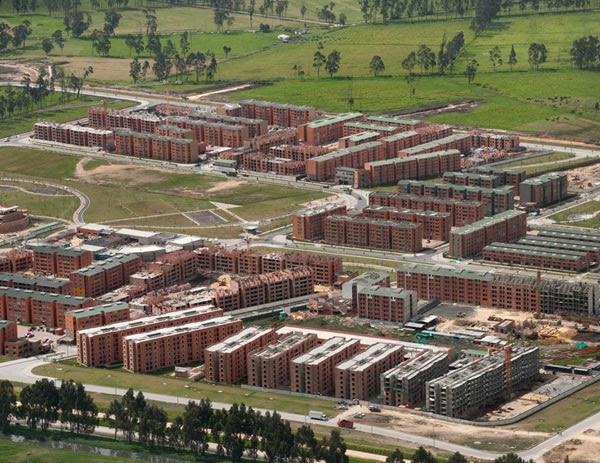
Ciudad Verde will have a major social impact in Colombia (and its model could be adopted elsewhere if successful). Developers will build 36,000 social housing units in the town of Soacha ranging in cost from US$20,000 to US$35,000 each and aiming to accommodate the desplazados – displaced rural townsmen who hail from conflict zones.  Newcomers will have access to a social reintegration program, while the development’s infrastructure includes hospitals, schools and hydroelectric power sources funded through public-private partnerships. (Source: KPMG International, Infrastructure 100: World Cities Edition, 2012)

The Ciudad Verde development involves a housing model called macroproyectos that aims to create small cities outside large urban developments – in this case the country’s capital Bogotá.  The satellite city is expected to create 21,000 jobs.  One third of the 800 acres will be dedicated to social housing, the rest to public space (green parks, roads, health centers, schools, etc.).  In Bogotá, high densities leave three meters of public space per person.  In contrast, Ciudad Verde will provide nine square meters of public space for each resident.  While many secluded low income housing "projects" tend to fail due to lack of access to the outside world, Ciudad Verde takes the important step of integrating Bogotá's TransMilenio bus rapid transit system to connect residents to the center of the capital city.  With such initial success and media attention, the project developers have already been approached by representatives from Valencia, Spain and from The National Fund of Mexico about the possible replication of the Ciudad Verde model and design frameworks.  (Source: Nace una Ciudad en Soacha, 2011)

 
The lead developer is Amarilo SA and their development partners include Bolívar, Colsubsidio, Soluciones Inmobiliarias, Ospinas-Emezeta, Marval, Prodesa, Urbansa and Mendebal-Coninsa Ramón H.  In total, the Ciudad Verde project will require US$145 million in investment with the developers expecting US$1.2 billion in revenue. (Source: Gran proyecto de vivienda social en Colombia, 2010)
Rendering Plan
Ciudad Verde Today
Ciudad Verde Today
Ciudad Verde Today


Share/Bookmark

Thursday, June 28, 2012

Infrastructure Demands of an Urban World

McKinsey Global Institute today published a report on worldwide urban growth.  Urban World: Cities and the Rise of the Consuming Class provides data that scream for huge investments in emerging markets' urban infrastructure.  The McKinsey report is so consistent with the city-building work at Gale International, that, like a sales pitch, it reaffirms our convictions of expanding middle classes and global urban needs.  Here are some excerpts from the report:


  • Cities that fail to meet the aspirations of the millions who are migrating in search of better opportunities run the risk of congestion, pollution, and insufficient public services becoming barriers to growth.
  • To deliver the benefits of economies of scale while minimizing the hazards of rapid growth, cities need to have professional planning and coordination, capable and accountable governance, and sustainable and responsible fiscal management.
  • If cities manage their capacity building well, there is a large opportunity not only for the world's investors but also to build more productive capacity that is less costly and more efficient in environmental terms for decades to come.  Importantly, the urban planning and infrastructure investment choices made today will determine how well cities are prepared for sustained growth after the expansive urbanization wave passes.  After most people have already moved to urban regions, cities will need to find new sources of productivity gains and economic growth.  Urban centers that have built well-functioning and efficient environments for businesses and individuals will be in a better position to attract skilled works and grow more productive businesses.
  • Cities will need annual physical capital investment to more than double from nearly $10 trillion today to more than $20 trillion by 2025.  Urban centers in emerging economies will make most of this investment.
  • McKinsey research in India suggests that it can be 30 to 50 percent less expensive for large cities to deliver basic services including water, housing, and education than it is in more sparsely populated rural areas.
  • Emerging market cities will account for close to half (47 percent) of expected global GDP growth between 2010 and 2025.
  • In China, for instance, spending on dining out starts to take off at annual incomes of around $3,000 per household and, by about $9,000, is on a firm and steep upward trajectory.  Spending on transport and communications starts increasing strongly as incomes reach around $6,000 per annum...Travel for leisure and retail banking services for deposits start climbing once per capita income reaches $18,000 per annum.

  • By 2025, cities will need to construct floor space equivalent to 85 percent of all of today's urban residential and commercial building stock...The urban building boom will require cumulative investment, including for replacement buildings, of nearly $80 trillion.
  • The investment needed to expand port capacity to 2025 exceeds $200 billion by our reckoning, with 85 percent of it taking place in emerging markets.


Share/Bookmark

Monday, May 28, 2012

Secondhand T-Shirt Dependency


The above TED Talk is an interesting look at the secondhand t-shirt market in developing countries.  Project Repat co-founder Ross Lohr explains how the used clothing industry fights dependency, reduces unemployment, and stimulates nascent industries. 100% donated goods have the effect of undercutting distribution chain systems (and other related industries) by flooding clothing markets with free goods.  On the other hand, NGOs like Good Will and The Salvation Army, which do not freely give away used t-shirts as donations, consist of surprisingly large industries and complex networks that sell secondhand clothes.  Lohr ultimately poses the question, if by giving donations for free "Are we really producing a sustainable, long-term impact in these countries or are we just undercutting local markets that haven't really had the opportunity to fully develop yet?"


Share/Bookmark

Friday, May 04, 2012

Eco-Industrial Parks


Eco-Industrial Parks (EIPs) cluster manufacturing plants in a single location where the by-products of one facility contribute to the inputs of other onsite facilities.  Seeking to create circular economies that recycle waste and encourage the sharing and integration of resources and infrastructure, EIPs facilitate “cleaner production within companies and design of both primary and by-product chains among companies.”  By promoting closed systems manufacturing, these parks encourage the local consumption of goods and recycling of by-product waste.  Incorporating a systems approach to these processes, EIPs can revolutionize sustainable industrial development.

Traditional industrial parks capitalize on the economic benefits of clustering.  The clustering of related business activity leads firms to gain additional productive advantages through increased specialization (in terms of human capital and physical infrastructure) and through efficient infrastructure networks.  Industrial parks typically concentrate like-businesses and companies around a common economic sector to capture these efficiencies. 

Instead of concentrating businesses based on a single industry, EIPs take clustering one step further – they create closed “waste-to-feed” resource systems.  EIPs assemble groups of companies based on waste production and inputs.  Planners and management teams organize eco-industrial parks by first identifying the by-products of large anchor tenants.  “If a major by-product supply stream will be an attractor to companies that can use it,” observes Ernest Lowe in an EIP case study, “then [EIPs] use that in recruitment.”   Planners and management teams embark down a successive chain of recruiting businesses that use the anchor tenants’ by-products as inputs and subsequently search for others who could utilize the next set of industrial by-products.  EIPs thus foster the development of closed resource systems and the perpetuation of circular economies.

At Hemaraj Eastern Seaboard Industrial Estates (HESIE) , an EIP located along the Gulf of Thailand, an automotive cluster sustains a 420-factory circular economy.  Anchored by Thailand’s automotive production lines, excess scrap metal is sold to parts manufacturers, to electronics companies, and to building-material factories within the industrial complex.  Plastics firms and agrochemical businesses reuse by-product gases produced at an electrical generation plant and at the automotive factories.  Co-generation heat capture powers additional energy throughout the industrial park.  

Similarly, the Industrial Symbiosis park in Kalundborg, Denmark houses 20 integrated firms.  Centered on a coal-fired power plant, excess heat from cooling water is directed to local fish farms and excess steam routed to the biotech facilities for enzyme production.  Both the fish farms and the pharmaceutical companies produce agricultural fertilizers as bi-products for pig feed in the nearby farms, which then feed Kalundborg’s residents.  Ash from the power plant is also used by the local cement company.  And a plasterboard manufacture utilizes the power plant’s sulfur dioxide and gypsum bi-products.


Share/Bookmark

Wednesday, April 18, 2012

Economic Success in Germany's Mittelstand


Share/Bookmark

Saturday, March 03, 2012

Russia's New Middle Class

Click to Enlarge
The middle class is the biggest driver of economic growth.  Promoting this class is the most surefire way of lifting vast groups of people from poverty.  Emerging markets (as well as many developing nations) are starting to experience economic expansion driven largely by the middle class.  

The Economist recently published the above graphic to show Russia's re-entrance onto the world stage (while at the same time arguing contrarily against Putin's power).  I imagine other BRIC countries have similar stats to those listed above.


Share/Bookmark

Sunday, January 22, 2012

Portland’s Planning Oasis

Portland, Oregon constantly wins Best City awards.  CNN named it in their 2010 Best Places to Live.  Popular Science ranked it “The Greenest City in America.” In his essay The Capital of Good Planning, Carl J. Abbott boastfully walks readers through a 30 year history of Portland’s planning and policy initiatives.  But despite successfully executed initiatives, Portland must attribute the bulk of its current urban landscape to a convenient lack of political conflict.

Due to its distance from the South, after reconstruction the northern migration of African-Americans never reached Oregon in the far Western corner of the country.  The greater metropolitan Portland records only a 3% black population.  As a result, Portland never experienced suburban white flight, naturally segregated neighborhoods, nor exclusionary zoning laws.  With racism a non-issue in Portland’s political arenas, mixed income residential zones never encountered paralyzing opposition that so often limits progressive policies. Tellingly, policies force the few existing suburbs to provide “appropriate types and amounts of land…necessary and suitable for housing that meets the housing needs of households of all income levels.”  These regulations mostly pointedly restrict suburbs, quintessential symbols of white flight, from enacting exclusionary zoning laws.  Without this “push-factor,” Portland’s residents never abandoned the center city.*

Portland's Urban Growth Boundary
Without suburbs, statewide political discussions evolved into a system of two distinct powers: rural farmers and city dwellers.  These two demographic forged a usually unexpected coalition.  One side seeks to protect the state’s agricultural economy while the other wants to promote city density.  Agricultural Republicans fight off dominating pressures from suburbs.  Environmentalist Democrats work to limit sprawl’s land consuming impacts.  The two create a powerful alliance with a common goal to concentrate development in the Portland’s center.  State programs advocate for the preservation of farmland alongside strict definitions of urban growth boundaries.  Since agricultural and density ideals are not in conflict, as often times these politically polarizing topics can be, the Farm Bureau and the city-centric Democrats established the Land Conservation and Development Commission, forging a convenient, yet cohesive marriage in Oregon.

Within the city proper, another unlikely union thrives, as both business and community interests benefit economically from a compact Portland.  Portland’s planning initiatives “focus activity on downtown.  In turn, a vital business center would protect property values in surrounding districts and increase their attractiveness for residential reinvestment.”  Property and business owners reap the financial rewards.  But communities also benefit as the central district’s “economic prosperity would support high levels of public services.”

Density inherently keeps infrastructure costs low, so the city can provide more for less.  This circularly keeps residents close to public parks and public transportation networks, which then increases the city’s ability to provide even more public services.  An uncharacteristically high 43% of Portland’s workforce travels to jobs using the city’s bus and train systems.  In another West Coast capital, Sacramento, that percentage drops to 11%.  A survey polling residents about their fears of the future of Oregon found one of top responses “becoming like California.”  Oregonians take pride in the society they have developed for themselves.

Further allying business and residential interests, mixed-use neighborhoods in Portland create a common goal atmosphere in the central business district and in communities.  This leads to the view that anyone within “five miles of the central business district” shares in the benefits of center city development and city-centric allocation of resources.  While highways typically encourage suburban sprawl, Portland’s freeway loops around the central business district instead of connecting the city to a suburban system of outer rings.  This inner-city freeway promotes the further establishment of the prominent city center.  Without adhering to suburban stakeholders, the city’s density mutually serves business and community wellbeing with one single set of jointly beneficial resources.

However, pacified political cohesion keeps the city’s development model and growth strategy from becoming a replicable standard in larger metropolitan contexts.  The same is often used in critiques of similar small cities like Vancouver.  Portland’s demographic make-up discourages suburbanization proponents as those voices get pushed to other cities in the region (the NIMBY, Not-In-My-Back-Yard, problem.)  Existing political coalitions builds unconquerable hurdles for opposition (like when voters “overwhelmingly” opted against paying for a trans-Columbia rail track).  Suburbanization will happen; just not around Portland. 

Hopes of reproducing Portland’s idealistic successes expose questions as to whether or not Portland’s growth model could sustain larger scale implementations.  Conventional thinking would suggest that a city that wins so much praise should provide an example of development and growth that others try to emulate.  But with a unique ability to build with a single, cohesive political vision, Portland efficiently invests its resources back into a city center – a home to businesses and residents alike, a home to one of America’s “most livable” cities.


*“Pull-factors,” such as the post-WWII economic boom that generally led to US suburbanization, also failed to reach Oregon, as the state experienced an industrial decline during this pivotal time period.


Share/Bookmark

Thursday, December 01, 2011

"Most of the [new city Songdo] will be wired with digital synapses—from the trunk lines running beneath the streets to the filaments branching through the walls and fixtures. To what end? [Songdo's developer] Stan Gale and his partners at Cisco Systems aren’t sure, but imagine if a city operated like an iPhone—and they could sell apps for everyday life..."  Greg Lindsay, City-in-a-Box 11/26/2011


Share/Bookmark

Monday, November 07, 2011

Delhi Mumbai Industrial Corridor

Dholera will transform from a collection of villages into a city of two million with its own international airport.

India plans to build 24 new industrial cities from the ground up.  As part of a $90 billion investment along a new high-speed rail line, the Delhi Mumbai Industrial Corridor will connect New Delhi and Mumbai (drastically cutting shipping times down from two weeks to 24 hours) and create a string of industrial cities to compete with those that house China’s Special Economic Zones. 

(Click to Enlarge)
To accomplish this ambitious series of mega-projects, politicians plan to leverage only $4.5 billion in public infrastructure investment, converting it into between $600 million and $1.6 billion (Rs 30 million and Rs 75 million) in total investment for each new city.  Forging partnerships with Japanese firms like Hitachi, Mitsubishi, JGC Corp, and Toshiba, India will acquire matching public funds from Japan and hope to attract the necessary capital investments in industrial facilities and housing.  The Indian state will first connect basic infrastructure such as roads, power, sewage, and water to the first site’s raw land.  Once divided into individual plots then sold, the state will reinvest the funds into the next city’s development – and the process will repeat for the remaining 23 cities.

In a major turning-point and test for India, Prime Minister Manmohan Singh will not only leverage the state’s capital investment to build these cities, but in a country widely viewed as inhospitable in the face of rampant corruption, the Prime Minister will also leverage India’s global reputation as he attracts foreign investment to  this emerging market's coming-of-age party.


Share/Bookmark

Wednesday, October 26, 2011

Desalinizing Ocean Water

As water increasingly becomes a scarce resource, China takes progressive measures to ensure its future dominance in the clean water sector.  Government financed infrastructure, like the North-South Water Diversion Project that aims to reroute the Yangtze River, prove excessively costly and ultimately unsustainable.  In response, the Chinese government has committed to theproduction of 800 million gallons a day of desalinized ocean water by the year 2020.  

Haihe River, Tianjin
China already tests its first filtration systems by pumping 10,000 tons of desalinized water a day into Beijing’s pipes.  At this point, desalinized water costs 8 yuan per cubic meter to produce, while water on the open market sells for 5 yuan.  But in some of China’s largest cities, like Tianjin where the first desalination plant is located, water already sells at a premium and prices are expected to rise 63% over the next 20 years in the country. 

The Desalination Process
(Click to Enlarge)
The industry plans to refine membrane filtration technologies until they become economically viable.  With tax-breaks, low interest loans, and an initial investment of $4 billion in a new desalination plant, China willingly accepts upfront losses in its quest to dominate the industry with 90% market power by 2020.  Future investments could reach another $31 billion.  As a result, the red nation already attracts the preeminent desalination firms in the world to its soil -- and not just for manufacturing; foreign R&D operations have already reestablishing their home bases.

"The [first desalination] plant is not profitable at present," recognizes Guo Qigang, general manager of China's operational desalination plant in Tianjin.  "But as the economy develops, its value will increase.  Desalination provides value for society."


Share/Bookmark

Thursday, October 20, 2011

Trade Wars: Solar Power Subsidies

Americans who rarely think about the adverse effects of free-trade agreements and who blindly promote them in the quest for “efficiency” can finally feel the pain these pacts inflict on the less dominant power.  The obvious outsourcing and flight of labor intensive jobs are standard during free-trade transitions.  But Americans can now also understand the darker side of uneven banking practices and of markets flooded with foreign subsidized production.  Yesterday’s filing of a broad trade case against China for subsidizing solar power manufacturers best exemplifies years of mounting karma.

President Obama speaks at Solyndra on May 26th, 2010.
In a news conference earlier this month, President Obama addressed issues with the solar power industry.  “Even if the technology was developed in the United States,” the President said, “they end up going to China because the Chinese government will say, ‘We’re going to help you get started, we’ll help you scale up, we’ll give you low-interest loans or no-interest loans, we will give siting, we will do whatever it takes for you to get started here.’”  Through what equates to a subsidy with no-interest loans, China props up its domestic solar power industry, creating imbalances that give Chinese industries an edge against competition.  But America does this all the time. 

Although it provided the solar power company Solyndra with a $535 million federal loan guarantee and a $25million state tax break, the US is losing at its own game, as Solyndra couldn’t compete and filed for bankruptcy over the summer.  When the US proposes free-trade agreements (like those passed with South Korea, Colombia, and Panama last week), the one-sided treaties allow for American farmers to flood foreign markets with US subsidized food.  Even the most efficient foreign farmers could never compete with the $5 billion a year US Farm Bill.  In another recent and visible example, Japan didn’t speak up when the Detroit auto industry effectively received the same loans under TARP.  In essence, Chinese solar power subsidies just sound like America getting a dose of its own medicine. 

As US policy makers simultaneously pass new free-trade agreements with the developing world and negotiate new subsidies for farmers at home, they attack currency manipulation and subsidizing bank practices in China.  American politicians fail to see the situation’s irony.  If the US fights to equalize trade practices with China, will developing nations follow America’s example and fight back against US subsidies?


Here's a NYTimes followup to yesterday's post: Solar Trade Case May Backfire on US Firms


Share/Bookmark