Monday, November 29, 2010

WikiLeaks


WikiLeaked US Military Video
WikiLeaks obtained another quarter million classified documents from US Embassies, congressional and foreign delegates, and administration officials discussing foreign politicians and affairs. In the first installment, WikiLeaks released 243 wire message cables.  The exposé site went a little too far with its publication of “Secret” and “Classified” documents that reveal confidential sources, putting many in current war zones and other sensitive areas at risk. Reckless publications could very likely have a compromising effect on future informants, as they fear repercussions of further leaks.  But considering the revelations within in the 251,287 cables, from an investigative reporting standpoint, I must say, HALLELUIAH!
Since Woodward and Bernstein published Deep Throat’s damning information about the Nixon administration, journalism has spiraled downhill, with media chasing business profits more than intellectual esteem.  WikiLeaks provides an incredibly deep look into the US’s approach to foreign affairs.  Embassy documents analyze Panamanian and Honduran dictators and coups.  Diplomats weigh nuclear reduction strategies in Iran and Pakistan.  Reports even prepare post-Kim Jong-il strategies for North and South Korea.  These reports infiltrate 270 embassies and consulates worldwide and provide unprecedented access to diplomatic thinking in the twenty first century.
While the Iraq and Afghanistan reports will receive the most attention (due to their sensitivity to current events), I’ve found the longer-term analyzes to be the most fascinating.  Here is an excerpt from a 2007 cable from the American Ambassador to Zimbabwe, Christopher W. Dell, breaking-down Robert Mugabe’s 27 year rule:
Zimbabwe President Robert Mugabe
Robert Mugabe has survived for so long because he is more
 clever and more ruthless than any other politician in
 Zimbabwe. To give the devil his due, he is a brilliant 
tactitian and has long thrived on his ability to abruptly
 change the rules of the game, radicalize the political
 dynamic and force everyone else to react to his agenda. However, he is fundamentally hampered by several factors:
 his ego and belief in his own infallibility; his obsessive
 focus on the past as a justification for everything in the
 present and future; his deep ignorance on economic issues 
(coupled with the belief that his 18 doctorates give him
 the authority to suspend the laws of economics, including
 supply and demand); and his essentially short-term,
 tactical style.
While his tactical skills have kept him in power for 27
 years, over the last seven this has only been achieved by a
 series of populist, but destructive and ultimately
 self-defeating moves. In reaction to losing the 2000 
referendum on the constitution, a vengeful Mugabe unleashed 
his "Green Bombers" to commit land reform and in the
 process he destroyed Zimbabwe's agricultural sector, once the 
bedrock of the economy. While thousands of white farmers
 saw their properties seized, hundreds of thousands of black 
Zimbabweans lost their livelihoods and were reduced to utter
poverty. In 2005, having been forced to steal victory by
 manipulating the results of an election he lost, Mugabe
 lashed out again, punishing the urban populace by launching 
Operation Murambatsvina. The result was wholesale
 destruction of the informal sector, on which as much as
 70-80 percent of urban dwellers had depended, and the
 uprooting of 700,000 Zimbabweans. The current inflationary cycle really began with Murambatsvina, as rents and prices
 grew in response to a decrease in supply.
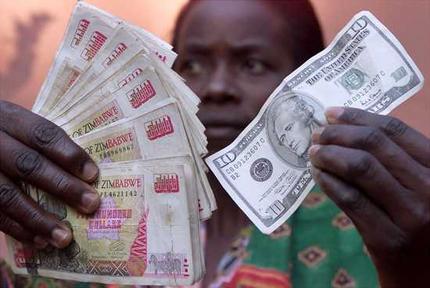
Zimbabwean Hyper Inflation
And now, faced with the hyper inflationary consequences
 of his ruinous fiscal policies and growing reliance on the printing press to keep his government running, Mugabe has
launched Operation Slash Prices. This has once again given
 him a very temporary boost in popularity (especially among the police, who have led the looting of retail outlets and 
now seem well positioned to take a leading role in the
 black market economy) at the cost of terrible damage to the
 country and people. Many small grocery and shop owners,
 traders, etc., will be wiped out; the shelves are
 increasingly bare; hunger, fear, and tension are growing;
 fuel has disappeared. When the shelves are still empty 
this time next week, the popular appeal of the price roll
 back will evaporate and the government simply doesn't have 
the resources to replace the entire private commercial
 sector and keep Zimbabweans fed. It may attempt to do so
by printing more money, adding even more inflationary
 pressure on a system already reeling from the GOZ's
 quasi-fiscal lunacy combined with the price impact of
 pervasive shortages. The increasingly worthless Zim dollar
is likely to collapse as a unit of trade in the near 
future, depriving the GOZ of its last economic tool other
than sheer thuggery and theft of others' assets.
With all this in view, I'm convinced the end is not far off for the Mugabe regime.
~Christopher W. Dell, US Ambassador to Zimbabwe, 7/13/2007

Share/Bookmark

Sunday, November 28, 2010

Evo vs The Church

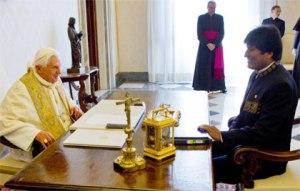
Pope Benedict XVI meets with Bolivian President Evo Morales

Evo Morales launched his newest attack against Bolivia's oldest political institution: the Church.  In his latest declaration, the Bolivian president wants to mandate full disclosure of church finances, expropriate churches and land, and eliminate religious tax exemptions.  Bolivia was officially a Catholic state as recently as a decade ago.  This direct attack on popular religious icons here couldn’t be a worse move.

The president’s rationale behind this blitz against the Church is that clergy in the country often exploit religious beliefs for personal gain.  Marriage, Baptism, and Mass fees do not contribute to the institution’s social funds or operating expenses; these go directly to the pockets of priests.  Living on donation footed bills, priests already reside in Church owned mansions and drive Church owned vehicles.  Evo’s aggression follows lock step with his promise to rid Bolivia of corruption – in all forms.  His cries for Church transparency, although politically sensitive, are well founded.

Going after Church land and the houses of worship themselves, however, goes too far. In a country where 85% of the nation is Catholic and an additional 10% is Evangelical, seizing property from religion is a political mistake and one that will infuriate citizens. People seek refuge in Churches and donate portions of their incomes in the name of their faith.  Stealing “God’s House” is a personal attack. 

Religious organizations are also the leading source of aid money in the country.  Now Evo wants to tax Churches and associated NGOs.  The Bolivian government clearly wants to take its piece of the religious donations pie.  Taxation would essentially be asking religious aid organizations to subsidize (anti-religious) government activity, which by mandate goes against the typical NGO, Non-Governmental Organization, calling. Taxing social causes could easily lead to funds flowing to more cost effective regions where every dollar spent could have more of a positive impact – both social and religious.  At the very least, these NGOs, already strapped with tight budgets, will assuredly cut social programs.

Even with the noble cause of increasing transparency, the Church has no reason to comply with the Bolivian government.  If the Vatican refuses to disclose finances or cede property, Morales is powerless to enforce these drastic measures.  Will the State arrest clergymen?  Will they send armed military into Churches?  In a country where the population supports the Church, unless Evo is preparing for a dictator sponsored civil war, he can’t possibly enforce these measures.  The Church has the upper hand.  Simply slighting the power hungry administration could easily shift public opinion fully to God’s side.

The Church may have been complicit with restrictions first removing religion from public schools (a fight they could not have won) and possibly with increased national transparency.  But, pairing financial disclosure with a war for Cathedrals, Churches, and Chapels is a lose/lose situation for Evo Morales.  This attack on the Church will surely have an adverse effect: empowering the religious institutions Evo seeks to restrain.  Other than increasing State control, what benefits could Evo Morales possibly gain from seeking to nationalize houses of worship?  This horribly engineered political move will only empower the administrations’ opponents.


Share/Bookmark

Thursday, November 25, 2010

China, The World's Second Largest Economy, Needs to Act as Such

Communist Party officials cry out “American intrusion” when the US sends warships into Asian waters in the Pacific.  “In history, foreign invaders repeatedly took the Yellow Sea as an entrance to enter the heartland of Beijing and Tianjin," said Chinese Major General Luo Yuan.  "The [Navy] drill area selected by the United States and South Korea is only 500 kilometers away from Beijing...We will never allow others to keep snoring beside our beds.”  Despite these harsh words and lofty ambitions, China has yet to act as the stabilizing regional power, opening the door for others assume this role.  In its own backyard, China watched from the sidelines as its neighbor North Korea tested nuclear weapons and as South Korean lost a naval ship after a torpedo attack.  When President Hu Jintao cowards away from confrontation, China’s void begs for American intervention.

North Korea's Kim Jong-il (left) and
China's Premier Wen Jiabao (right)
With North Korea’s provocative behavior paired with an insistence on developing nuclear power, China needs to take the reigns and pressure Kim Jong-il.  China accounts for almost 60% of North Korea’s exports and more than 40% of its imports. According to The Guardian, China provides North Korea with close to half of its food and 90% of its energy.  China has strong economic influence in North Korea.  Conversely, North Korea’s insignificant impact on the Chinese economy doesn’t even account for 0.03% of commerce (Yes, that decimal is correct – that’s three one-hundredths of a percent).  North Korea’s $3 billion of trade with China is inconsequential to China’s overall GDP of $8.7 trillion.  

President Hu Jintao has the economic might (accompanied by minimal potential economic hazard) to pressure North Korea – the type of economic threat that Obama lacks.  But Jintao refuses to strong-arm its turbulent neighbor into obedience with forceful economic diplomacy.  Party officials in the red state abstain from acknowledging North Korean hostility.  After Kim Jong-il tested atomic missiles, paraded scientists around nuclear facilities, torpedoed foreign vessels, and now attacked a small island; unaffected Chinese officials have yet to condemn North Korea aggression and at best comment on the rogue state ambiguously.

The USS George Washington is
expected to arrive at the Korea
Peninsula on Sunday.
When Japan fought with China over maritime borders in September, China showed the world it wanted to control the East China Sea.  China forcefully restricted rare earth exports to Japan until The Land of the Rising Sun caved into Sino demands.  Now, the world’s second largest economy needs to fully assume its duty as a power of this magnitude and become a leading Asian authority.  If China can’t stand up to dangerously volatile, attention-seeking countries like North Korea, they invite traditional forces to bring warships into the region to establish stability.


For further reading on North Korean aggression, read B.R. Myer's "North Korea Will Never Play Nice."


Share/Bookmark

Friday, November 19, 2010

Expectations for the Sox Offseason

The 2010 MLB season was a disappointment for the Red Sox.  Injuries, inconsistent pitching, and the most competitive division in sports resulted in a disappointing end for the Boston club.  As the pre-Thanksgiving, first round of GM meetings take place, the only news (beyond the usual conjecture and speculative media hype) to come out of Orlando is that the owners are pushing for the likely addition of a 2012 wildcard playoff round.  Finishing third in the AL East, behind the Yankees and the Rays, the Sox would have qualified for this Wildcard Playoff.  Instead, the sixth ranked team in the league started an early offseason.

During the GM meetings last year, 2010 appeared to be a rebuilding season for the ballclub, with farm system prospects set to graduate in 2012.  Theo Epstein, Tom Werner, and John Henry spent the meetings defending the club’s ability to contend.  The front office responded with acquisitions of Jon Lackey, Mike Cameron, and Adrian Beltre.

Try this hat
on for size
This year, the Sox have no catcher or third baseman and only half a bullpen.  The front office indicated it will aggressively pursue a free agent outfielder. Carl Crawford has been consistent throughout his career (.307 AVG and .824 OPS in five of the past six seasons).  Jayson Werth’s past four seasons in Philly have been stellar (.881 OPS).  Unfortunately, Werth strikes out too much for the Sox liking (147 SOs in 2010, down from 156 in 2009).  With that in mind, the Sox also tend to shy away from age in long-term deals (Werth is 31 vs Crawford 29.)  Remember, the Sox wouldn’t go past the $60M, four-year offer for the 31-year-old Jason Bay last season.  So expect a bigger push toward Crawford.  (Strangely, the front office has to know that the competitive market for these two superstars will probably drive their price tags into the five-year, $80M range – a risk Epstein has only once before taken with a position player, JD Drew.  History has yet to convince me of the sincerity of comments regarding courtship with these two.)

Ells a DBack?
Assuming the front office goes after Carl Crawford, Francona would have four everyday caliber outfielders. Expect a BIG trade centered around Jacoby Ellsbury.  Don’t listen to the propaganda that Ells and the front office are best friends after last season’s public berating Ells and agent Scott Boras gave the medical staff.  Convenient as it may be, Jacoby is still the biggest trade chip the Sox have in the outfield.  Although Ellsbury isn’t the deadweight in the outfield, neither JD Drew nor Mike Cameron could bring an impact player to Boston.  Their contracts are too large for any bidder to accept their mediocrity (respectively, $14M for .255 AVG and $7.75M for 48 games last season).  Ellsbury, on the other hand, is just becoming arbitration eligible this year and only receive $496,500 last season (perfect for a cash strapped franchise like San Diego).  Jacoby could easily be converted into a Justin Upton or an Adrian Gonzalez, but Epstein will also be open to an acquisition of a premier reliever and a top prospect.

When Will We
See Iglesias in
a Sox Uniform?
The average and expendable Marco Scutaro is going to be perfect trade bait for a solid reliever.  Since there are a handful of teams with holes at short this year, Scut might even bring the Sox a couple of decent arms.  The rest of the ‘pen will be filled using the usual Theo magic, picking up tons of cheap arms and having them fight for roster spots (the market is saturated with relievers).  The Sox then have options at short.  They will at least make a serious play for Justin Upton.  If Arizona asks for too much (Although the Sox will gladly offer up Ellsbury, I don’t see Theo parting with Daniel Bard), Boston could easily start the season with Jed Lowrie at SS and in August platoon in prospect and first future franchise short stop since Nomar, Jose Iglesias (Cuban defector with .295 Minor League AVG in 2010).

Will Theo Make a
Push for Gonzalez
This Offseason
or Next?
This time last year, I wrote, “[T]he Sox don't have any infield prospect Major League ready. Since there is a fairly decent sized class of third base free agents available this off season, my guess is that Theo is waiting for a cheap bargain to pop up just before Spring Training. I'm fine with waiting to get a cheap, year long replacement for Lowell.”  Epstein then signed Adrian Beltre to a one-year deal.  Expect the same this year.  Theo seems set to make a full-court press for Adrian Gonzalez (and move Youkilis to third) after the end of the 2011 season.  The front office could easily start that push now.  More likely, Theo will decide that it’s not worth losing Ellsbury in a trade for a player the Sox will inevitably sign next winter (trade or no trade, they would have to sign Gonzalez to a new contract or an extension).  Without a deal with the Padres, Epstein will wait for Gonzalez to hit free agency.  Look for another one-year solution at third.

Welcome V-Mart
Back to Boston
As for catcher, the Sox may not like Victor Martinez behind the plate, but they will be forced to pick him up.  John Henry will probably have to pay up for more years than the front office would like simply because their hands are tied.  Jarrod Saltalamacchia has yet to prove himself and the Sox can’t risk entering the season with such a big unknown.  When they do sign “Victory” Martinez, look for the contract to be front-loaded so the front office can trade him away after two years.

In summary, if the Sox sign Carl Crawford, as they’ve indicated, the expendable Jacoby Ellsbury will become the central trading chip of a blockbuster deal.  Look for Marco Scutaro to get moved to address dire bullpen needs.  And almost certainly, get ready for an overpaid (four years) Victor Martinez to resume duties behind the plate.


Share/Bookmark

Thursday, November 18, 2010

Our Hedge Fund Republic

To follow up the "Our Banana Republic" Op-Ed I now mention in three recent posts, Nicholas Kristof responded to his critics with a fire.
"My point was that the wealthiest plutocrats now actually control a greater share of the pie in the United States than in historically unstable countries like Nicaragua, Venezuela and Guyana. But readers protested that this was glib and unfair, and after reviewing the evidence I regretfully confess that they have a point. 
That’s right: I may have wronged the banana republics.
You see, some Latin Americans were indignant at what they saw as an invidious and hurtful comparison. The truth is that Latin America has matured and become more equal in recent decades, even as the distribution in the United States has become steadily more unequal."


To hear more of Kristof's fact based defense, I encourage you to read "A Hedge Fund Republic?" To follow the recent US inequality discussion on "Just A Thought...", scroll through Failed Latin American Policy Applied at Home and American Inequality - At Least It's Not Socialism.


Share/Bookmark