Showing posts with label Revolution/Movements. Show all posts

Tuesday, October 07, 2014

How Export Industrialization Spurs Growth

"Export success trickles down to the rest of developing economies. Since producers of non-traded goods and services, such as housebuilders and lawyers, must compete with exporters for labour, they need to pay attractive wages. At the same time the chance of well-paid work in manufacturing creates an incentive for workers to move to cities and invest in education. An industrialising export sector is like a speedboat that pulls the rest of the economy out of poverty." -- Emerging Economies: Arrested Development


Share/Bookmark

Monday, January 06, 2014

End of the BRICs

"When the [BRIC] acronym came into common use, a decade ago, the BRIC countries—Brazil, Russia, India, and China—contributed roughly 20 percent of global economic growth. Although China was already the heavyweight, it did not yet dominate: in 2004, the country contributed 13 percent of global growth in gross domestic product, while Brazil, Russia, and India combined contributed 9 percent, with similar growth rates. Compare that with the experience of the past two years. China accounted for 26 percent of global economic growth in 2012 and for 29 percent in 2013. The collective share of Brazil, Russia, and India has shrunk to just 7 percent."


Share/Bookmark

Friday, May 17, 2013

The Port of Paulsboro


EXECUTIVE SUMMARY
In a push to adapt and reposition itself in a global 21st century economy, the South Jersey Port Corporation and the Gloucester County Improvement Authority are re-outfitting a closed industrial site to create a multimodal port in Southern New Jersey.  This report analyzes existing conditions at the port site and explores how infrastructure improvements contribute to the port’s productive advantage.

Because of contamination at an old oil storage and distribution facility, BP cheaply leased their property to the Borough of Paulsboro as the site to develop a marine port facility.  Benefiting from a strategic location along the Delaware River, the port inherits centuries of accumulated infrastructure surrounding it.  An existing marine channel backbones the site, while Shortline and Class 1 railroads and an interstate highway connect the marine terminal to the American hinterland.

Investments in infrastructure that support freight movement will facilitate port operations and further promote commerce in the region.  Major stimulus begins with remediation of industrial land and the construction of the new marine terminal, but additional improvements enhance the Port of Paulsboro’s connectivity.   Track expansions in Paulsboro and in the region add to the rail network’s reach.  A new Freight as a Good Neighbor access road allows trucks to avoid residential neighborhoods when connecting from the port to the interstate highway.  And the Missing Moves Project seeks to alleviate bottleneck congestion along the regional truck corridor.

With a large tract of land, Paulsboro also offers customizable co-location opportunities that allow for value-added distribution or manufacturing on site.  This becomes especially important since the port is positioned to handle specialty cargo.  Combined with unique multimodal access, this flexibility gives the port a competitive edge in handling and processing heavy steel plates for offshore wind turbines.  Reaping the benefits of these productive advantages, the port expects to create 2,500 jobs, while the offshore wind industry will employ an additional 2,000 workers.  In total, employment multipliers predict the port to support 20,000 direct and indirect jobs.

Other redeveloped brownfield sites at Keystone Industrial Port Complex in Bucks County and the less-than-effective iPort12 distribution center in Carteret further emphasize the requisite formula for developing a new port – it all depends on improving existing freight networks.  Successful brownfield redevelopment projects leverage cheap land with extensive infrastructure networks to create hubs where port functions and value-added industrial services support one another.  Cohabitation provides a productive advantage that attracts new industrial activity and creates jobs.  Following this proven development model, the Port of Paulsboro capitalizes on its inherent advantages as it revives an old industrial hub in South Jersey.


Share/Bookmark

Thursday, May 09, 2013

Iranian Presidential Elections

Mahmoud Ahmadinejad (left) and Hooshang Amirahmadi (right)

My graduate school advisor and professor of Urban Economics is running for President in Iran.  A revered political and international development consultant to leaders in Washington and in London, Professor Hooshang Amirahmadi always contended that a Western approach to governance could quickly turn around the fortunes of Iran and speedily increase its development.  Below is the economic platform Professor Amirahmadi presents to Iran.

Of all the issues Iranians confront in deciding their next president, the economy is the most imperative. With a high inflation rate, widespread unemployment, sluggish growth, low productivity, plummeting national currency, plunging industrial production, declining income, widening income gap, and growing poverty, hardly anyone in the country is immune from the dismal state of the economy. This is unfortunate since Iran is actually a wealthy country with vast natural resources, a highly-educated workforce, arable land, diverse climates, access to the strategic waterways, and many other favorable attributes.

The economic problems and the mismatch between Iran’s economic achievements and its rich resources are largely rooted in mismanagement and economic sanctions. These and other underlying causes are removable and thus the economic problems entirely solvable if the upcoming presidential election was to produce the right executive leadership. The next president must understand Iran’s economic predicament and its causes, comprehend the world economy, and be able to put an economic development plan for the nation and implement it using a skillful team of economists and international advisors.

As President of Iran, I will turn Iran’s economic plight around by formulating an economic plan based on three principles: economic productivity, export-led industrialization, and labor-market globalization. I will also immediately remove sanctions and mismanagement by resolving the nuclear dispute, normalizing relations with the West, resolving factional infighting and appointing a highly competent economic and international advisory team. These steps will help in opening the global economy to Iran and in establishing a stable economic policy, thus creating a climate of permanency and certainty for productive investments.


Share/Bookmark

Wednesday, March 06, 2013

Venezuelan President Chavez Pronounced Dead: Initial Knee-Jerk Reaction

While I have not yet done my full due-diligence and fully read up on the situation, here is my initial thoughts on the passing of Venezuelan President Hugo Chavez:

It will be interesting to see how the political situation in Venezuela shakes out.  Already the Vice President booted US Diplomats from the Bolivarian nation.  Might this be a sign of another power grab stranglehold?  Or is it an honest attempt at avoiding foreign tampering?  I remain skeptical and err towards a fight for power.


Venezuelan President Hugo Chavez
Source: Washington Times
Originally Chavez took control via coup and then spent a decade and a half shooting down political opposition.  After his death, there will surely be a mystery as the question of what happens next unravels.  A new set of democratic elections would surely be best, but it is likely that someone else from within the inner circle will try to fill the power vacuum -- someone less charismatic than Chavez who will likely not have the same support of the people that the socialist leader had.  A new power grab will probably lead to unrest and uncertain times in Venezuela.  My guess is that it will take a handful of years and a few bad leaders before the country can right the ship after the past decade plus under Chavez.  Think of Egypt -- it's hard to reestablish political cohesion after strongman politics disappears instantly.  Expect the same in Venezuela, where public support for socialism is polar split, the economy constantly flirts with runaway inflation, and the high-stakes game of oil is too lucrative to ignore.


Share/Bookmark

Tuesday, August 14, 2012

Technology Infrastructure


“A 2009 World Bank study found that raising mobile-phone penetration in a developing country by ten percentage points increased GDP growth by 0.8% a year.”The Economist, Telecommunications in Brazil,8/11/2012

Every publication about technology’s effect on the developing world always reminds me of my first exposure living in Latin America.  While living on an island off the shore of Costa Rica, I spent time with a subsistence fisherman who used a cellphone to work his way out of poverty.  Outfitted with the technology of a cellphone, the fisherman could check market prices of fish in the capital city and break the tradition of get ripped off by wholesalers at the local pier.

World Bank, 2010
The spread of cheap technology is extremely encouraging in how it revolutionizes economic development.  While new technologies and gadgets have changed Western economies, their affects are strongly felt in low and middle income countries even more so.  In a 2010 study, the World Bank found that for every 10 percent increase in broadband access, developing economies accelerated growth by 1.38 percent (for comparison, total US growth hovers at 1.7 percent).

Capitalizing on this trend, Campus Tecnológico in Guatemala created an urban enclave of telecommunications facilitated businesses and start-ups.  As part of a three phased public/private development collaboration, Campus Tech aims to change the Central American technology industry by investing in young entrepreneurs and providing them with broadband infrastructure and local database centers.  Campus Tech has already facilitated 28 start-ups and has subscription backlogs for the first phase of its wired office-complex.  “In Guatemala,” reads a NYTimes article on Campus Tech, “many entrepreneurs have been focusing on the union of technology and social policy, creating things like affordable water filters, or a program for distributing health information to cellphones.”  

Technology infrastructure and their facilitators like Campus Tech truly have the power to drastically stimulate economies and alter life in developing countries.


Share/Bookmark

Thursday, August 09, 2012

The Ambassador


This political documentary tops my list of films to watch.  Danish director Mads Brügger "attempts an even more complex and daring stunt by purchasing a Liberian diplomatic title and infiltrating one of the most dangerous places on Earth -- the Central African Republic (CAR) -- as an ersatz Ambassador. His purpose? To expose the illegal blood diamond trade -- and the corrupt world of CAR officials, bogus businessmen and shady European and Asian diplomats that it benefits." -- The Huffington Post


Share/Bookmark

Friday, August 03, 2012

What the US Needs: A Return Cold War America


Neil Armstrong, 1969
Talking about the Olympics, a friend noted the US was beating China in the medal count. "In China they give athletes military positions so they can officially hold jobs while still competing as amateurs.  But we still beat ‘em" This conversation reminded me of Cold War rhetoric and how times have changed. In the Cold War, Americans never complained about how the USSR gave special treatment to their citizens. When the Soviets sent a man to space, the US made it a national priority to send a man to the moon. We used all our resources to ensure that the United States of America stayed the most competitive power on the planet.

Now, with China climbing the rankings and growing into the world's second largest economy, the US confronts this opponent with a passive mindset.  Outcries call for China to stop manipulating their currency and complaints rain about their below market value, state-backed loans.  The US “diplomatically” pleads with China to stop the practices that led the Red State to a golden age.  Responses to China’s growing power are passive at best.  What ever happened to America’s Cold War mentality of taking all steps necessary to out-compete rivals?

US (blue) vs China (red)
Confronted by China's cheap currency, unfounded inflation fears cause US inaction and leave Americans stuck with 8% unemployment (four years into the economic crisis and the US still has below-target inflation!). Instead of worrying about China's decisions to subsidize infrastructure investments with low interest loans, Congress weakly passes base-boned stop-gap transportation bills and continues to obstruct the formation of our own infrastructure banks (a novel proposal to leverage public/private partnerships and spur investment).  While cheap Chinese labor strips America of manufacturing jobs, proud Americans focus attention on strengthening high-end service professions and skilled labor.  But cutting teachers’ pay and decreasing education spending undermine any movement towards these lofty ideals.  This is not the America that worked to ensure its superiority against a Communist foe.

Instead of outcompeting China, America fights a losing battle against itself from within. The US fails to address aging infrastructure. The Fed sits idle, indecisively postponing important action.  Our country needs to rethink its misdirected complaints about China.  America needs to abandon its passive mentality and actively invest in a prosperous future.


Share/Bookmark

Tuesday, July 24, 2012

India's Persisting Caste System

In a fascinating explanation of why the caste systems persists in India, Kaivan Munshi of Brown University explores how generations-old social networks perpetuate an 'unbreakable' class hierarchy:

"In the stylized world described by introductory economics textbooks, the market provides insurance and credit for people to invest and make purchases. Workers find jobs instantaneously and are paid a wage in line with their ability. The real world, especially a developing economy, does not function in this way. Market insurance is unavailable to a large section of the population. Bank credit is also unavailable without collateral, either because banks cannot observe whether borrowers are creditworthy or because they will refuse to repay their loans even when they can. Finally, many individuals do not get the jobs they deserve, either because they don’t have the money to invest in costly education or because potential employers have no way of knowing how able they really are and so will be reluctant to hire them.

"In such an economy, social networks will often emerge in response to market failures. Members of a tight-knit social group, living in the same neighborhood or sharing kinship ties, are well aware of the creditworthiness and the ability of each other. Members of such groups can also be sanctioned for reneging on their commitments. This allows social groups to form informal ‘mutual insurance arrangements’ and to provide loans to their members. Employed workers can also help capable unemployed members of their group find a job by providing referrals. Social networks thus work in parallel with the market economy, supporting the economic activity of their members in many different ways.

"In India, individuals continue to marry almost exclusively within their (sub) caste or jati. [Less than five percent of the respondents in all the surveys I have conducted, in rural and in urban India, marry outside their caste.] Given the segregation along caste lines that continues to characterize the Indian village, most social interactions also occur within the caste. The jati is thus the natural social unit around which networks would crystallize in India. Indeed, rural insurance arrangements and urban job networks have long been organized around the jati. It is this relatively unexplored feature of the caste system – the ability of the caste to provide major forms of economic support to its members – that I believe has much to do with its persistence in modern Indian society."

To read Munshi's full article or others about India's unique economic and social structure, please visit the new blog site Ideas for India for More Evidence Based Policy.


Share/Bookmark

Friday, July 13, 2012

Case Study: Ciudad Verde


Site Plan
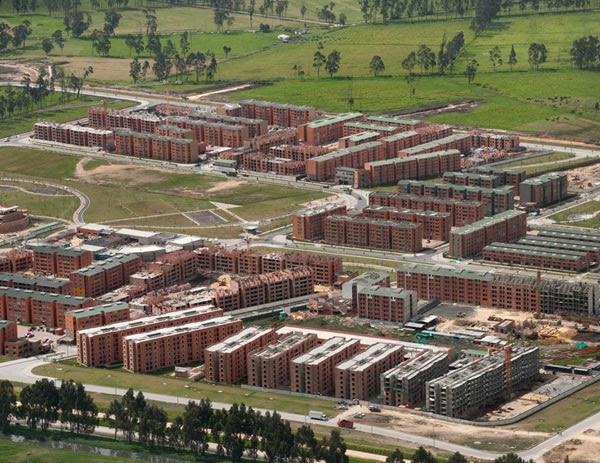
Ciudad Verde will have a major social impact in Colombia (and its model could be adopted elsewhere if successful). Developers will build 36,000 social housing units in the town of Soacha ranging in cost from US$20,000 to US$35,000 each and aiming to accommodate the desplazados – displaced rural townsmen who hail from conflict zones.  Newcomers will have access to a social reintegration program, while the development’s infrastructure includes hospitals, schools and hydroelectric power sources funded through public-private partnerships. (Source: KPMG International, Infrastructure 100: World Cities Edition, 2012)

The Ciudad Verde development involves a housing model called macroproyectos that aims to create small cities outside large urban developments – in this case the country’s capital Bogotá.  The satellite city is expected to create 21,000 jobs.  One third of the 800 acres will be dedicated to social housing, the rest to public space (green parks, roads, health centers, schools, etc.).  In Bogotá, high densities leave three meters of public space per person.  In contrast, Ciudad Verde will provide nine square meters of public space for each resident.  While many secluded low income housing "projects" tend to fail due to lack of access to the outside world, Ciudad Verde takes the important step of integrating Bogotá's TransMilenio bus rapid transit system to connect residents to the center of the capital city.  With such initial success and media attention, the project developers have already been approached by representatives from Valencia, Spain and from The National Fund of Mexico about the possible replication of the Ciudad Verde model and design frameworks.  (Source: Nace una Ciudad en Soacha, 2011)

 
The lead developer is Amarilo SA and their development partners include Bolívar, Colsubsidio, Soluciones Inmobiliarias, Ospinas-Emezeta, Marval, Prodesa, Urbansa and Mendebal-Coninsa Ramón H.  In total, the Ciudad Verde project will require US$145 million in investment with the developers expecting US$1.2 billion in revenue. (Source: Gran proyecto de vivienda social en Colombia, 2010)
Rendering Plan
Ciudad Verde Today
Ciudad Verde Today
Ciudad Verde Today


Share/Bookmark

Monday, May 28, 2012

Secondhand T-Shirt Dependency


The above TED Talk is an interesting look at the secondhand t-shirt market in developing countries.  Project Repat co-founder Ross Lohr explains how the used clothing industry fights dependency, reduces unemployment, and stimulates nascent industries. 100% donated goods have the effect of undercutting distribution chain systems (and other related industries) by flooding clothing markets with free goods.  On the other hand, NGOs like Good Will and The Salvation Army, which do not freely give away used t-shirts as donations, consist of surprisingly large industries and complex networks that sell secondhand clothes.  Lohr ultimately poses the question, if by giving donations for free "Are we really producing a sustainable, long-term impact in these countries or are we just undercutting local markets that haven't really had the opportunity to fully develop yet?"


Share/Bookmark

Wednesday, April 04, 2012

Hedonistic Sustainability


In this TED Talk with Bjarke Ingels, the world renowned architect demonstrates how innovative design can creatively integrate buildings with society.  A new city hall in Thailand incorporates government transparency and public participation in physical form by making conference rooms open to public view from the outside.  A waste-to-energy plant in Copenhagen draws a mountain form into the Copenhagen skyline (with rooftop ski slope included!).  The power plant also raises awareness of carbon emissions by releasing the gaseous byproduct in equally measured smoke rings to give residents a psychical interpretation of one ton of CO2.  In what is most likely the first Just a Thought... post on architecture, the cultural implications and the pure "wow" factor of the Bjarke Ingels Group's works speak for themselves.  Expect to see new Bjarke Ingels inspired constructions across the world in the 21st century.

Good looking out to Mr. Pomeroy for finding this video.


Share/Bookmark

Saturday, March 03, 2012

Russia's New Middle Class

Click to Enlarge
The middle class is the biggest driver of economic growth.  Promoting this class is the most surefire way of lifting vast groups of people from poverty.  Emerging markets (as well as many developing nations) are starting to experience economic expansion driven largely by the middle class.  

The Economist recently published the above graphic to show Russia's re-entrance onto the world stage (while at the same time arguing contrarily against Putin's power).  I imagine other BRIC countries have similar stats to those listed above.


Share/Bookmark

Friday, February 10, 2012

The Island President Deposed


Film maker Jon Shenk crafted an extremely moving 6 minute documentary about Mohamed Nasheed, the now ex-president of the Maldives (Nasheed was forced out of office by gunpoint on Tuesday).  The short film walks through Nasheed's rise from political prisoner to first democratically elected leader of the Maldives.  As a vulnerable enclave of islands, Shenk follows the president's push to make the islands the first carbon neutral country in the world.  His fight against international business pressures leads up to this week's unrest.  To visually experience Nasheed's rise and fall, watch the short film above or read Shenk's written chronicle of the Maldives president.


Share/Bookmark

Wednesday, February 01, 2012

City-Scale Development: A Look into How New Cities Ease the Infrastructure Burdens of the 21st Century

Karachi, Pakistan, houses 13 million residents and presides over 95% of Pakistan’s foreign trade, but poor infrastructure destines the overcrowded megacity to endure everlasting poverty.  The Karachi Mega Development Project report of 2005 blatantly acknowledges that the deteriorated quality of Karachi’s infrastructure “impacts adversely on the country’s economic growth and development prospects.”  Households allege to only having running water for a few hours every other day.  Pipe leakages lose an estimated 50% of all drinkable water and the leaks’ detriments to water pressure only exacerbate the problem.  Nonetheless, the shortfalls of the sewage systems make the water network admirable in comparison. 

Only one quarter of Karachi’s sewage successfully journeys through “undersized and broken sections” of the sewage network to the city’s wastewater treatment plants.  Once there, the plants suffer from operating at 50% overcapacity.  The Mega Development Project report asserts that “annual flooding causes both damage to homes and infrastructure, and constitutes a significant health risk from floodwaters contaminated by the raw sewage which flows in the drainage network.”

Unfortunately, the infrastructure problems that plague Karachi are not unique.  Growing urban populations across the globe expose the limitations and the finite durability of ever thinly-stretched city infrastructure.  Many existing water pipes, inner-city roads, and sewage systems, often built for the cities of yesteryear and a pre-seven billion inhabitant world, have already surpassed or are approaching their maximum capacities.  Sadly, fixing existing problems tends to be too costly a burden for city and national governments, and cost-cutting maneuvers lead to poorly constructed, short-term solutions.

However, instead of expensively retrofitting infrastructure through piecemeal reconstruction, a modern trend has provided governments a long-term, cost effective way to house expanding populations: New City construction.

Thoroughly engineered, decongested cities allocate resources more efficiently through their fully integrated infrastructure – an indispensable trait that will prove a matter of survival in a sustainable 21st century.  As efficiency demands increase and technologies speed globalization, master planned cities also add needed economic benefits by defining clear regional roles in the world economy.  Planners, engineers, and architects now design cities specifically to give industries naturally built advantages.

As the world hastily industrializes and urban populations relentlessly grow, the overcrowding problems that infected the dreary, 20th century rapidly industrializing cities now reach every corner of the globe.  Yet decentralized, new urban systems help mitigate population growth to rates manageable enough for cities to address infrastructure demands.  New cities can alleviate these increasing pressures while joining populations to an international, globalized world economy.


Share/Bookmark

Tuesday, January 24, 2012

Learning from History (17th Century Spain)

17th Century Spanish Swordsmen
“In Spain, repeated bankruptcies between 1557 and 1647 were coupled with desperate measures to stave off disaster.  War, the church, and administering the complex bureaucratic system provided the major organizational opportunities in Spain and in consequence the military, priesthood, and the judiciary were rewarding occupations.  The expulsion of the Moors and Jews, rent ceilings on land and price ceilings on wheat, confiscation of silver remittances to merchants in Seville (who were compensated with relatively worthless bonds called juros) were symptomatic of the disincentives to productive activity…

“The most telling evidence of the increasing returns feature of the Spanish institutional fabric was the inability of the crown and its bureaucracy to alter the direct of the Spanish path in spite of their awareness of the decay and decline overcoming the country.  In a century – the seventeenth – Spain declined from the most powerful nation in the Western world since the Roman empire to a second-rate power…

“Jan De Vries in his study (1976) of Europe in the age of crisis describes the effort to reverse the decline as follows:

“But this was not a society unaware of what was happening.  A whole school of economic reformers…wrote mountains of tracts pleading for new measures…Indeed, in 1623, a Junta de Reformacion recommended to the new King, Phillip IV, a series of measure including taxes to encourage earlier marriage (and, hence, population growth), limitations on the number of servants, the establishment of a bank, prohibitions on the import of luxuries, the closing of brothels, and the prohibition of the teaching of Latin in small towns (to reduce the flight from agriculture of peasants who had acquired a smattering of education).  But no willpower could be found to follow through on these recommendations…It is said that the only accomplishment of the reform movement was the abolition of the ruff collar, a fashion which had imposed ruinous laundry bills on the aristocracy.” -- Douglass C. North, Institutions, Institutional Change, and Economic Performance


Share/Bookmark

Sunday, January 22, 2012

Portland’s Planning Oasis

Portland, Oregon constantly wins Best City awards.  CNN named it in their 2010 Best Places to Live.  Popular Science ranked it “The Greenest City in America.” In his essay The Capital of Good Planning, Carl J. Abbott boastfully walks readers through a 30 year history of Portland’s planning and policy initiatives.  But despite successfully executed initiatives, Portland must attribute the bulk of its current urban landscape to a convenient lack of political conflict.

Due to its distance from the South, after reconstruction the northern migration of African-Americans never reached Oregon in the far Western corner of the country.  The greater metropolitan Portland records only a 3% black population.  As a result, Portland never experienced suburban white flight, naturally segregated neighborhoods, nor exclusionary zoning laws.  With racism a non-issue in Portland’s political arenas, mixed income residential zones never encountered paralyzing opposition that so often limits progressive policies. Tellingly, policies force the few existing suburbs to provide “appropriate types and amounts of land…necessary and suitable for housing that meets the housing needs of households of all income levels.”  These regulations mostly pointedly restrict suburbs, quintessential symbols of white flight, from enacting exclusionary zoning laws.  Without this “push-factor,” Portland’s residents never abandoned the center city.*

Portland's Urban Growth Boundary
Without suburbs, statewide political discussions evolved into a system of two distinct powers: rural farmers and city dwellers.  These two demographic forged a usually unexpected coalition.  One side seeks to protect the state’s agricultural economy while the other wants to promote city density.  Agricultural Republicans fight off dominating pressures from suburbs.  Environmentalist Democrats work to limit sprawl’s land consuming impacts.  The two create a powerful alliance with a common goal to concentrate development in the Portland’s center.  State programs advocate for the preservation of farmland alongside strict definitions of urban growth boundaries.  Since agricultural and density ideals are not in conflict, as often times these politically polarizing topics can be, the Farm Bureau and the city-centric Democrats established the Land Conservation and Development Commission, forging a convenient, yet cohesive marriage in Oregon.

Within the city proper, another unlikely union thrives, as both business and community interests benefit economically from a compact Portland.  Portland’s planning initiatives “focus activity on downtown.  In turn, a vital business center would protect property values in surrounding districts and increase their attractiveness for residential reinvestment.”  Property and business owners reap the financial rewards.  But communities also benefit as the central district’s “economic prosperity would support high levels of public services.”

Density inherently keeps infrastructure costs low, so the city can provide more for less.  This circularly keeps residents close to public parks and public transportation networks, which then increases the city’s ability to provide even more public services.  An uncharacteristically high 43% of Portland’s workforce travels to jobs using the city’s bus and train systems.  In another West Coast capital, Sacramento, that percentage drops to 11%.  A survey polling residents about their fears of the future of Oregon found one of top responses “becoming like California.”  Oregonians take pride in the society they have developed for themselves.

Further allying business and residential interests, mixed-use neighborhoods in Portland create a common goal atmosphere in the central business district and in communities.  This leads to the view that anyone within “five miles of the central business district” shares in the benefits of center city development and city-centric allocation of resources.  While highways typically encourage suburban sprawl, Portland’s freeway loops around the central business district instead of connecting the city to a suburban system of outer rings.  This inner-city freeway promotes the further establishment of the prominent city center.  Without adhering to suburban stakeholders, the city’s density mutually serves business and community wellbeing with one single set of jointly beneficial resources.

However, pacified political cohesion keeps the city’s development model and growth strategy from becoming a replicable standard in larger metropolitan contexts.  The same is often used in critiques of similar small cities like Vancouver.  Portland’s demographic make-up discourages suburbanization proponents as those voices get pushed to other cities in the region (the NIMBY, Not-In-My-Back-Yard, problem.)  Existing political coalitions builds unconquerable hurdles for opposition (like when voters “overwhelmingly” opted against paying for a trans-Columbia rail track).  Suburbanization will happen; just not around Portland. 

Hopes of reproducing Portland’s idealistic successes expose questions as to whether or not Portland’s growth model could sustain larger scale implementations.  Conventional thinking would suggest that a city that wins so much praise should provide an example of development and growth that others try to emulate.  But with a unique ability to build with a single, cohesive political vision, Portland efficiently invests its resources back into a city center – a home to businesses and residents alike, a home to one of America’s “most livable” cities.


*“Pull-factors,” such as the post-WWII economic boom that generally led to US suburbanization, also failed to reach Oregon, as the state experienced an industrial decline during this pivotal time period.


Share/Bookmark

Saturday, January 21, 2012

"Yesterday the number of people living in [Chinese] cities exceeded the rural population for the first time...Urban dwellers now represent 51.27 percent, or 690.8 million people, of China’s entire population of nearly 1.35 billion." -- Taipei Times (1/18/2012)


Share/Bookmark

Thursday, December 29, 2011

"The United States will add a new inhabitant every 17 seconds and an immigrant every 46 seconds." -- El Deber on the US Census


Share/Bookmark

Tuesday, December 20, 2011

China's Housing Bubble?


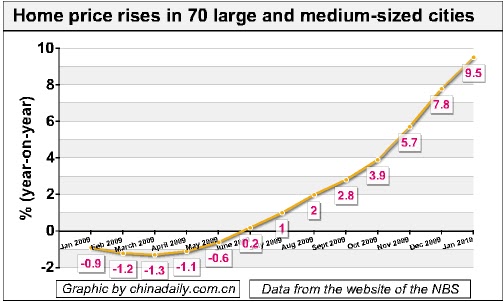
Earlier this week, a quick, two sentences from The Economist jumped out at me as the most important part of a long article on the Chinese economy.  China “struck a hawkish note on the eve of the [Politburo] conference, promising to remain ‘unswerving’ in its campaign against property-market speculation.  That sent Shanghai’s stock market index down to its lowest level since March 2009, with property developers suffering especially.”  Next to this magazine column, I scribbled a note to myself to ask a friend in real estate whose firm is looking to develop land in China about what sounded like the popping of a bubble.  This could spell trouble for new city development in the region, especially since Chinese officials are starting to worry about clear signs of excessive speculation.

Rising home prices in China cause need to worry.
Yesterday, Paul Krugman, voiced similar worries about the Chinese real estate bubble. “Real estate investment has roughly doubled as a share of G.D.P. since 2000, accounting directly for more than half of the overall rise in [China’s] investment…which has soared to almost half of G.D.P.” He continued, “As credit boomed, much of it came not from banks but from an unsupervised, unprotected shadow banking system…In China as in America a few years ago, the financial system may be much more vulnerable than data on conventional banking reveal.”

It is wrong to conclude that China does not need more housing – it clearly needs to provide modern living amenities for its urbanizing population – but bubbles are less about housing demand than about credit crunches.  Often times, overly cheap access to credit and rapidly rising real estate prices lead to imbalances in housing supply and demand.  Instead of treating housing as a home for living, it becomes a tradable commodity.  In the US, for example, the recent housing crash did not occur in reaction to a sudden drop in demand for homes for people to live; the population keeps growing.  However, among other causes, inconsistencies in financial markets led to housing prices (as a commodity) dropping below the value of mortgages, leading to people accepting foreclosure when real estate market prices fell below existing mortgage balances.

As both The Economist and Dr. Krugman noted, reliable data from the Chinese are closely guarded secrets, the truth about real estate markets remains murky.  Investors, instead of relying on market indicators, should pay attention to the government’s attack on speculation and its signaling pre-emptive acknowledgement of boom-bust market cycles (which in China may already be too far underway to steer against the current).  Over-exuberance should always be reason to question the status-quo.  Chinese government action should be as well.


Share/Bookmark